.png)
The Bourboneur Secondary Market Index has traveled from a January low to a spring high and back below zero—revealing a market caught between resilient collector demand and a much less forgiving economic environment.
On August 10, the Bourboneur Secondary Market Index sat just 0.57 percent below where it began the year. At first glance, that sounds like a market where almost nothing happened.
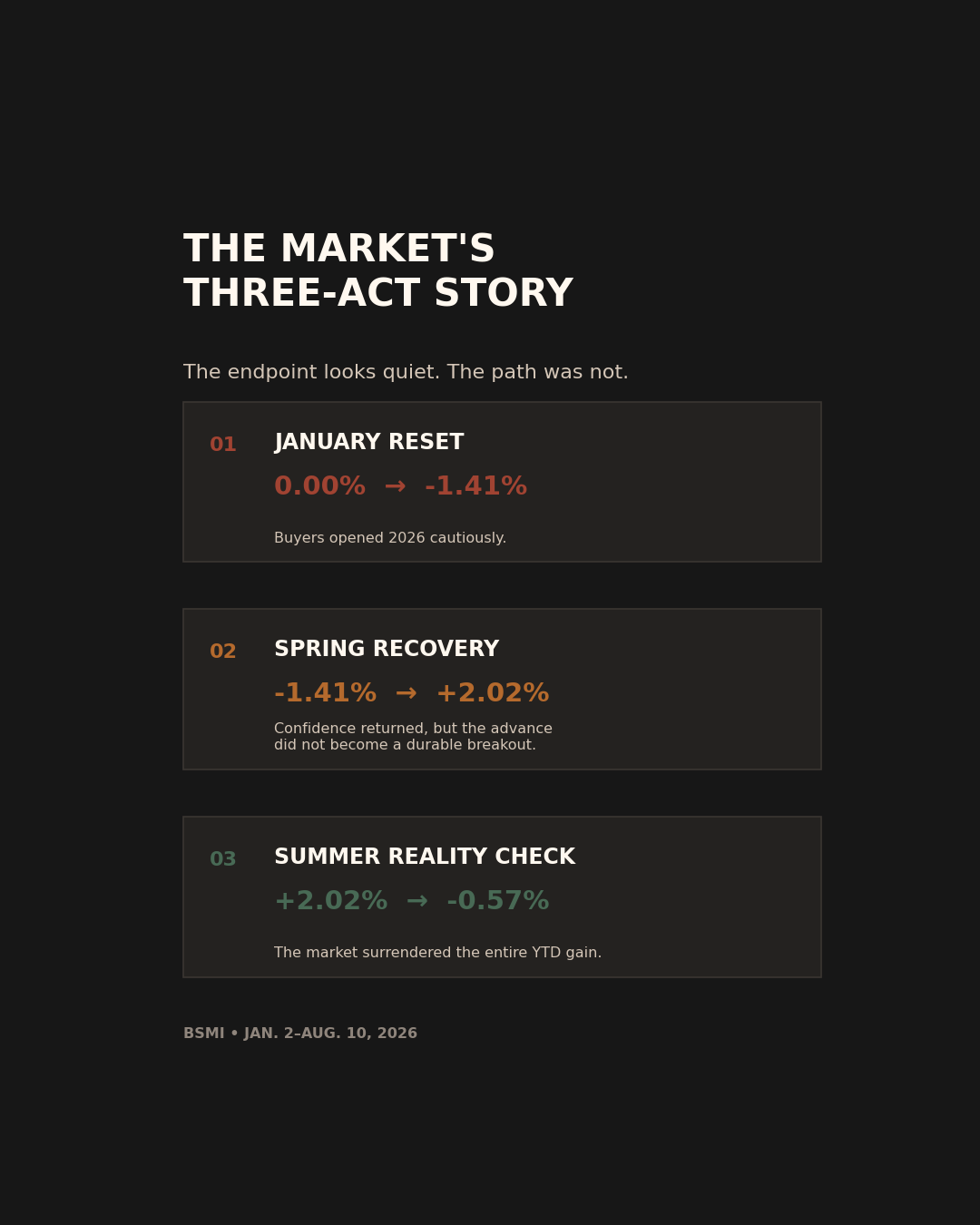
The index opened 2026 at zero, fell to a low of -1.41 percent on January 30, recovered into positive territory in late March, climbed as high as +2.02 percent on June 6, and then surrendered the entire advance by early August. A nearly flat endpoint arrived by way of a decidedly non-flat journey.
The better way to understand 2026 is not as a collapse or a comeback. It is a market searching for equilibrium. Collectors remain engaged, but the conditions that once made nearly every hard-to-find bottle feel like a one-way bet have changed.
.png)
January delivered the reset. The caution that had been building in the secondary market carried into the new year, and prices moved lower quickly. Buyers had not disappeared; they were simply less willing to chase.
Then came the spring recovery. The index crossed back above zero on March 25 and continued climbing through April and May before reaching its +2.02 percent YTD high in early June. For a moment, it looked as though the market might be ready to turn the page on the correction that defined much of 2024.
The summer had other ideas. By the end of July, nearly all of the index’s gain was gone. On August 1 it moved below zero again, reaching -0.57 percent by August 10.
That round trip matters more than the final number. It shows that buyers will step in when value appears, but it also shows how difficult it has become for the broader market to sustain momentum.
Bourbon does not trade on an exchange, and collectors do not make decisions solely by watching Federal Reserve meetings. But the economics surrounding discretionary purchases still matter.
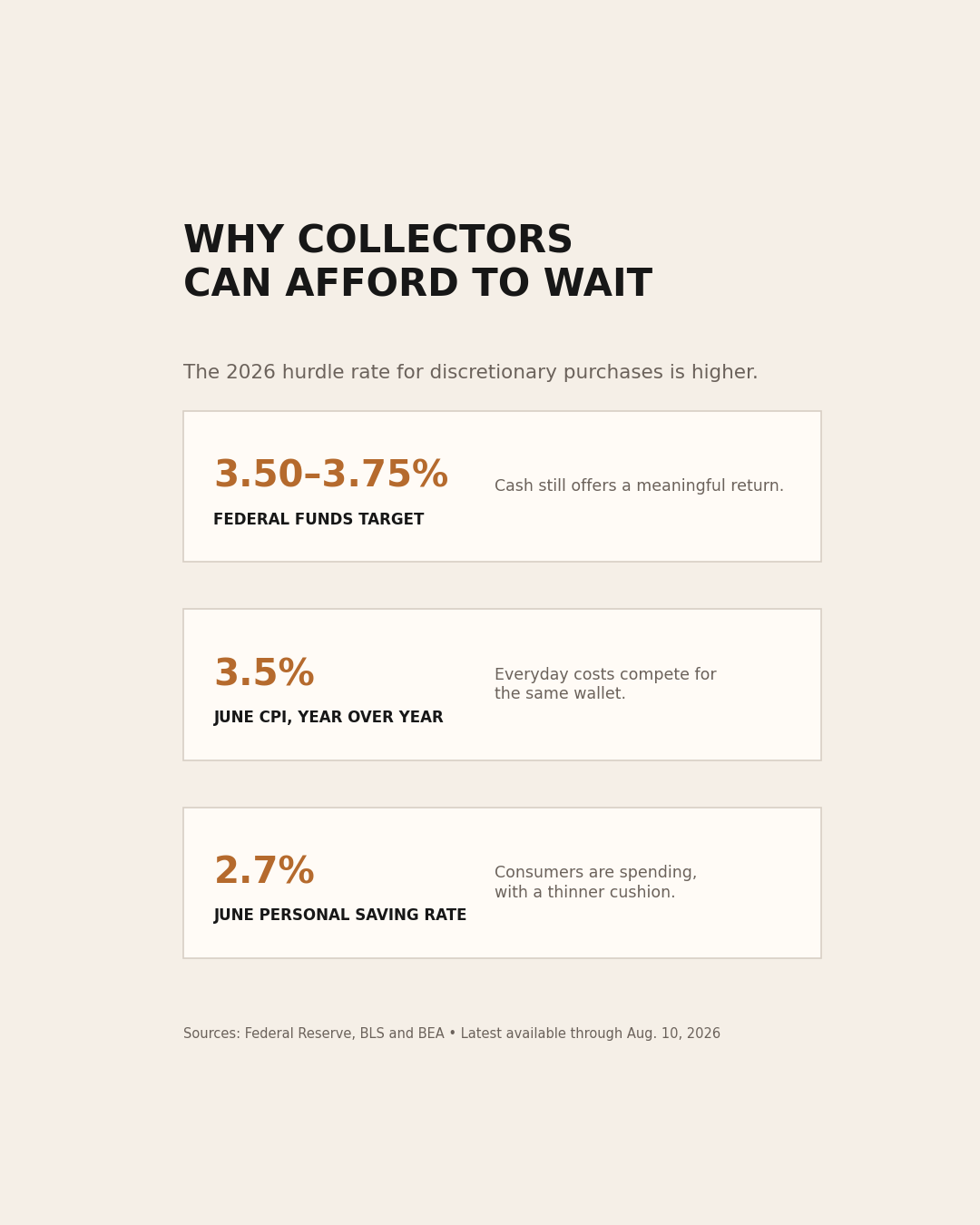
At the end of July, the Federal Reserve was holding its target interest-rate range at 3.50 to 3.75 percent. Inflation was still running at 3.5 percent year over year in June. Consumers continued spending, but the personal saving rate had fallen to 2.7 percent.
Put those conditions together and the hurdle rate for a secondary-market purchase rises. Cash can earn a meaningful return. Everyday expenses continue to absorb more of the household budget. And buyers have less reason to stretch for a bottle today if they believe another opportunity will appear tomorrow.
This is not recessionary panic. It is selectivity. The buyer is still present—just more patient, more informed and less willing to treat allocation status as proof of future value.
The bourbon industry’s broader backdrop reinforces that change in psychology. Kentucky is holding a record inventory of aging spirits. Across the U.S. spirits market, supplier revenue declined in 2025 even as physical volume increased. American spirits exports also weakened amid trade friction and the loss of important Canadian business.
None of that means a warehouse full of aging bourbon directly increases the supply of a particular collectible release. The secondary market is more specialized than that, and genuinely rare bottles remain genuinely rare.
But the larger consumer environment has unmistakably changed. There are more distilleries, more special releases, more premium expressions and more alternatives competing for the same collector’s attention. Bourbon has moved from an era dominated by shortage expectations toward one increasingly defined by choice.
For years, the bourbon boom trained buyers to expect a familiar sequence: find the bottle, buy the bottle and watch the secondary value rise. That reflex was powerful enough to elevate allocation itself into a selling point.
The 2026 index suggests that reflex is weakening. Reputation, quality, heritage and lasting enthusiast demand matter more when buyers have options. A recognizable label may still command attention, but attention alone no longer guarantees appreciation.
That is not necessarily bad news for bourbon. Markets that mature become more discriminating. They separate durable demand from temporary excitement. They force pricing to become more closely connected to what collectors truly value rather than what they fear missing.
The result may be less spectacular than the broad appreciation of the late 2010s and early 2020s. It may also be healthier.
At -0.57 percent, the Bourboneur Secondary Market Index is not flashing a crisis. It is showing a standoff.
Collector enthusiasm remains strong enough to support the market when pricing becomes attractive. The economic environment, however, is demanding enough to prevent every recovery from turning into a sustained rally.
That tension may define the remainder of 2026. Fall release season will bring new attention, new pricing and the usual fear of missing out. But this year’s data suggests buyers will approach that excitement with a little more discipline than they once did.
Bourbon is still collectible. Scarcity is still powerful. The difference is that the market is becoming more particular about what earns the premium—and that may be the most interesting signal in an otherwise flat year.
A flat market doesn’t mean bottle values aren’t moving. Track the Bourboneur Secondary Market Index, monitor your collection, and check current secondary values in the Bourboneur app before your next buy or trade.
Track the market →
.png)


.png)
.png)
.png)
0 Comments