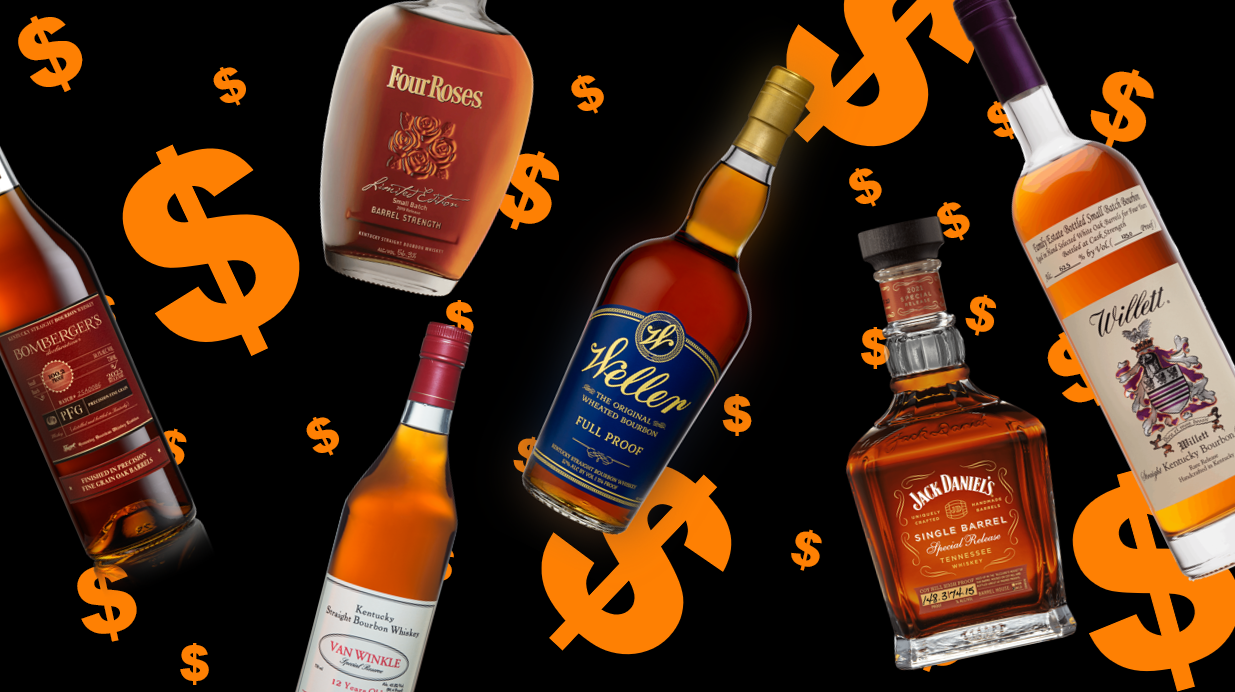
At some point in the last few years, bourbon pricing became less about data and more about confidence. Not informed confidence—just confidence. The kind that shows up loudly in comment sections, private groups, and DMs that begin with, “What’s this worth?”
You know the answers that follow. They’re delivered quickly, decisively, and almost never with any supporting evidence. And yet, they carry weight. Bottles get bought. Bottles get sold. Screenshots get saved. Prices get repeated until repetition becomes “truth.”
Which brings us to the modern bourbon pricing expert—and the unofficial starter pack that seems to accompany the role.
It usually starts with a photo. Not a clean product shot, mind you, but a dimly lit, slightly crooked picture of a bottle resting on a cluttered shelf. The label may be cut off. The year is unclear. The lighting suggests the photo was taken somewhere bourbon goes to retire. Still, the bottle exists, and that’s apparently enough.
Next comes a reference point. Not a current sale, but a memory. “I’ve seen it go for…” is the most powerful phrase in the secondary market, capable of conjuring prices from any moment in the last decade. When pressed for details—when, where, or whether the bottle actually sold—things get hazy. Time, after all, is a construct.
MSRP often enters the conversation here, too. It’s spoken of reverently, despite having very little to do with what bottles actually trade for. In theory, MSRP anchors reality. In practice, it mostly serves as a reminder that someone, somewhere, paid far less than you’re about to.
Comparisons soon follow, and this is where things really open up. One bottle becomes “basically the same” as another, despite differences in release year, proof, supply, or demand. A single loosely related sale becomes a benchmark. Context quietly exits the room.
What’s missing from all of this isn’t passion or enthusiasm—those the bourbon world has in abundance. What’s missing is time. Recency. Direction. Is the bottle gaining momentum? Cooling off? Quietly rebounding? Those questions rarely get asked, and almost never answered. Prices are treated as static numbers, frozen at their most convenient moment.
And to be fair, this isn’t malicious. It’s human. Bourbon for some time has grown faster than the tools used to track it, and for a most of that time, anecdotes were all anyone had. The problem is that the market didn’t stay small. It matured. It segmented. It started behaving less like a hobby and more like… a market.
That’s where the gap becomes obvious.
Because while opinions are plentiful, actual transaction data is not. Knowing what a bottle sold for once is interesting. Knowing what it’s selling for now—and how often—is useful. Knowing whether those prices are holding, slipping, or accelerating is the difference between guessing and understanding.
This is why bourbon pricing feels so confusing right now. Not because it’s unpredictable, but because too much of the conversation is still anchored in noise. When pricing is built on echoes instead of evidence, the loudest voices win, not the most accurate ones.
The irony is that beneath all of that chatter, the market is telling a very clear story. Some bottles have softened. Some have stabilized. Some remain stubbornly resilient despite endless declarations of their demise. You just have to look at what’s actually happening, rather than what’s being repeated.
So yes, the bourbon pricing expert starter pack is funny because it’s familiar. We’ve all seen it. Most of us have probably used pieces of it ourselves at some point.
But as the bourbon world continues to grow up, the way we talk about value needs to grow with it. Less “I’ve seen it go for,” and more “here’s what’s actually happening.”
Confidence is easy.
Clarity takes work.
And in a market this crowded, clarity is the real luxury. 🥃
The bourbon market isn’t broken.
The conversation around it is.
When prices are repeated instead of verified, when memories replace momentum, and when confidence outweighs context, the result is a lot of noise and very little clarity. That’s how good bottles get mispriced, opportunities get missed, and myths hang around long after the market has moved on.
What cuts through that isn’t another hot take—it’s perspective. Knowing not just what a bottle once sold for, but what it’s doing now.
That level of clarity doesn’t come from starter packs or screenshots. It comes from watching the market in real time, across regions, releases, and price tiers—and letting the data do the talking.
If you’re serious about understanding bourbon value—not guessing at it—the difference becomes obvious pretty quickly.
Drink what you love.
Price what you know.
That’s the line between collecting confidently and chasing echoes. And it’s exactly where the Bourbon Blue Book® lives.
If 2025 taught us anything, it’s that the bourbon market doesn’t pause. Drop season is now year-round, bottles hit the secondary before receipts cool, and the gap between hype and heritage has never been wider.
Navigating that requires more than instinct—it requires truth in numbers. The same approach that recently earned Bourboneur recognition from Forbes.
That’s why we built the Bourbon Blue Book®. With live, verified secondary sales data on over 9,000 bottles, it exists to help you avoid overpaying for shelf noise—or missing the undervalued gems hiding in plain sight.
Inside the Bourboneur app, you get:
• Real-Time Market Data – No guesswork. Just what bottles are actually selling for.
• The Blue Book Advantage – At $3/month or $25/year, it pays for itself the first time you walk away from a bad deal.
• A Growing Community – Thousands of collectors using data—not hype—to stay Whiskey-Wise.
Whether you’re hunting a 16-year Old Commonwealth or pricing a fair trade, don’t fly blind in 2026.
📲 Download the app on iOS or Android.
📩 Subscribe below for our weekly insider email.
📷 Follow along on Instagram, Facebook, and TikTok.
That’s Bourboneur.
.png)


.png)
.png)
.png)
0 Comments