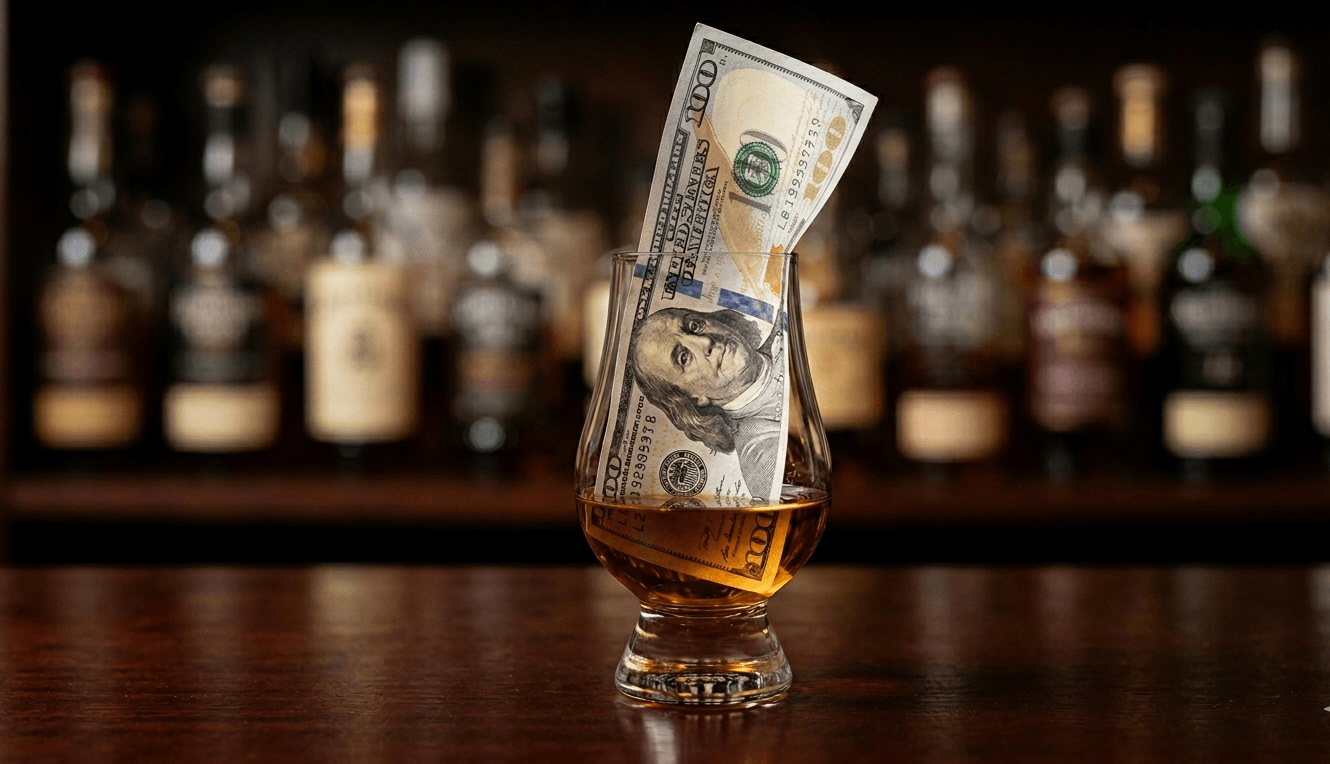
There’s a moment most bourbon drinkers eventually have.
You’re holding a glass of something special—maybe a bottle you hunted for months, traded into, or paid a little more than you’d like to admit. You take a sip, enjoy it, maybe even love it. And then, somewhere in the back of your mind, a question creeps in:
“What did that pour just cost me?”
Not what you paid for the bottle. Not MSRP. Not even what your buddy said it’s “worth.”
What did that actual pour cost—right now, today?
The answer is usually… more than you think.
Most people mentally anchor to what they paid.
• “I got this for $120, so it’s about $6 a pour.”
• “This was a $60 bottle—easy daily drinker.”
That math feels clean. Logical. Safe.
But it’s also wrong.
Because bourbon—especially in today’s market—isn’t static. The moment you walk out of the store, crack the seal, or even let it sit on your shelf, the value can change. Sometimes dramatically.
That $120 bottle might now trade for $300.
That $60 pickup might quietly be a $150 bottle.
And that dusty you grabbed years ago? That’s a different conversation entirely.
So if you’re still calculating cost-per-pour based on what you paid, you’re not measuring cost.
You’re measuring history.
Let’s reframe it.
There are really two ways to think about a pour:
1. Acquisition Cost (what you paid)
2. Current Market Value (what it’s worth today)
The first is fixed. The second is constantly moving.
And if you care about understanding what you’re actually drinking, the second one matters more.
Because every time you pour a glass, you’re not just consuming liquid—you’re consuming value.
Take a hypothetical bottle:
• You bought it for: $100
• Current market value: $250
• Bottle size: ~17 pours
Your mental math:
$100 ÷ 17 = ~$6 per pour
Reality:
$250 ÷ 17 = ~$14.70 per pour
That’s more than double.
And that gap? That’s the difference between what you think you’re drinking and what you’re actually drinking.
Now scale that up to higher-end bottles:
• $80 → now $400
• $150 → now $600
• $300 → now $1,200
Suddenly, that “casual” pour isn’t so casual anymore.
It’s not ignorance—it’s human nature.
We don’t like recalculating value in real time. We especially don’t like realizing that something we’re about to consume might be “worth more” than we’re comfortable with.
So we default to purchase price. It’s easier. Less emotional.
But in a market where prices move fast—and sometimes irrationally—that shortcut creates a blind spot.
You might:
• Open bottles you would’ve held
• Hold bottles you would’ve enjoyed
• Trade poorly
• Overpay without realizing it
All because you’re operating on outdated information.
Ten years ago, this conversation barely existed.
Today, it’s unavoidable.
The secondary bourbon market has introduced:
• Real-time pricing dynamics
• Regional variability
• Rapid swings in demand
• A widening gap between MSRP and reality
Whether you participate in it or not, it affects you.
Because it defines what your bottle is worth—not just what it was.
And that value follows your bottle everywhere:
• On your shelf
• Into your glass
• Into every decision you make about it
Short answer: no.
Long answer: it depends on what you value.
If bourbon is purely about enjoyment for you, then drink it. That’s the point. Always has been.
But if you’re someone who:
• Collects
• Trades
• Tracks bottles
• Or even just wants to be informed
Then understanding true cost isn’t about guilt—it’s about clarity.
It gives you control.
It lets you decide:
• Which bottles are “drink now”
• Which are “maybe later”
• Which are “don’t even think about opening”
And most importantly—it helps you avoid surprises.
Instead of asking:
“What did I pay for this?”
Start asking:
“What is this worth today?”
That one shift changes everything.
It turns bourbon from a static purchase into a dynamic asset—whether you like that framing or not.
And it brings a level of awareness that most people don’t have.
This is exactly the problem Bourboneur was built to solve.
Not to tell you what to drink.
Not to tell you what to buy.
But to give you a clear, current picture of what your bottles are actually worth—so you can make better decisions with them.
Because whether you’re:
• Pouring it
• Holding it
• Trading it
• Or just admiring it
You should know what’s in your glass.
And what it’s really worth.
One Last Thought
Next time you pour something special, pause for a second.
Not to overthink it. Not to second-guess the moment.
Just to recognize it.
Because that pour isn’t just bourbon anymore.
It’s a choice.
If 2025 taught us anything, it’s that the bourbon market doesn’t pause. Drop season is now year-round, bottles hit the secondary before receipts cool, and the gap between hype and heritage has never been wider.
Navigating that requires more than instinct—it requires truth in numbers. The same approach that recently earned Bourboneur recognition from Forbes.
That’s why we built the Bourbon Blue Book®. With live, verified secondary sales data on over 10,000 bottles, it exists to help you avoid overpaying for shelf noise—or missing the undervalued gems hiding in plain sight.
Inside the Bourboneur app, you get:
• Real-Time Market Data – No guesswork. Just what bottles are actually selling for.
• The Blue Book Advantage – At $3/month or $25/year, it pays for itself the first time you walk away from a bad deal.
• A Growing Community – Thousands of collectors using data—not hype—to stay Whiskey-Wise.
Whether you’re hunting a 16-year Old Commonwealth or pricing a fair trade, don’t fly blind in 2026.
📲 Download the app on iOS or Android.
📩 Subscribe below for our weekly insider email.
📷 Follow along on Instagram, Facebook, and TikTok.
That’s Bourboneur.
.png)


.png)
.png)
0 Comments