
Walk into almost any well-stocked liquor store and the oak vocabulary starts piling up quickly. Double Oaked. Double Barrel. Toasted Barrel. Triple Oak. Double Double Oaked. The words sound precise—almost as if each one belongs to a category with an agreed-upon recipe—but bourbon does not work that neatly.
Some of these terms point to a recognizable production choice. Others are names a producer created for one particular release. Two bottles can use nearly identical language while taking very different routes from the first barrel to the finished whiskey. That does not make the language meaningless, and it does not necessarily make it misleading. It simply means the front label rarely tells the whole story.
Then there is the question that follows once the process is understood: does all that additional oak make the bottle more valuable? Bourboneur Blue Book data offers a fairly clear answer. Sometimes it does—but the market is rewarding the bottle, not the number of times the word oak appears on the label.
Bourbon itself is tightly defined. Federal standards specify the grain requirement, distillation proof, barrel-entry proof and the use of new charred oak containers. Straight bourbon adds a minimum of two years in new charred oak. Those words carry requirements.
Double Oaked and Triple Oak are different. They are not federally defined classes of whiskey, and there is no universal formula that every producer must follow before placing either phrase on a bottle. In practice, the terms describe real maturation or finishing decisions, but the producer has to explain what its particular version means.
Bourboneur Translation: Treat Double Oaked and Triple Oak as invitations to read the process—not as standardized guarantees of how many barrels were used, how long the whiskey spent in them or what the finished bourbon should taste like.
In its most familiar form, double oaked bourbon begins life in the new charred oak barrel required for bourbon and later moves into another oak barrel for additional maturation. That second barrel gives the producer a new set of choices: new or previously used wood, a different toast or char profile, a rejuvenated barrel, and a secondary maturation that may last months or years.
Woodford Reserve Double Oaked is the category’s most recognizable example. Woodford moves its bourbon into a second barrel that is deeply toasted and then lightly charred. The additional wood contact is designed to pull forward the darker caramel, chocolate, vanilla and toasted-oak notes that have made the bottle an everyday benchmark.
Kentucky Peerless takes a similarly direct approach but describes the result as two full barrel extractions from two separate casks. Peerless Double Oak started, fittingly enough, with a leaking barrel that forced the whiskey into a second new charred oak barrel. What began as a practical save became a permanent expression because of the additional body and complexity the second barrel produced.
River Roots demonstrates how much room exists inside the same basic idea. Its 10-year Double Oaked releases begin with mature sourced whiskey and use carefully selected secondary barrels to create limited, often high-proof offerings. The label still says Double Oaked, but the age, source whiskey, finishing barrel, proof and scarcity can make each release a distinct proposition.
Toasting heats the wood more gradually and penetrates deeper into the stave, developing sugars and compounds associated with vanilla, caramel, baking spice and other sweet oak notes. Charring exposes the surface to intense flame, creating the familiar blackened layer inside a bourbon barrel. Producers can use one, the other or a combination of both, and the exact profiles matter. That is why “finished in a second oak barrel” is only the beginning of the explanation.
Woodford Reserve’s Double Double Oaked is a useful example of producer-specific language. The name does not mean four barrels. It starts with fully matured Woodford Reserve Double Oaked and extends the whiskey’s time in the second, deeply toasted and lightly charred barrel. Earlier distillery releases used an additional year; Woodford’s current expression emphasizes an extended secondary maturation rather than a new industry category.
The nationally released Barrel Finish Select bottling brought that process to a larger audience in a more elaborate 700-milliliter presentation—and at a $200 MSRP. It is a handsome bottle, but after tasting it alongside standard Woodford Double Oaked, I struggled to find enough separation in the glass to justify paying more than three times the price. The richer presentation is obvious. For me, the improvement in the whiskey was not.
The market appears to be wrestling with the same value equation. Standard Double Oaked carries a $60 MSRP but is available at Total Wine for about $48, close to its $52 Blue Book value. Double Double Oaked launched at $200, while Total Wine lists it near $189 and its Blue Book value is $174. In both cases, MSRP is not where buyers are actually settling.
Bourboneur Insight: MSRP is a suggestion. The market determines value. A Blue Book value below MSRP does not necessarily mean a bottle has failed; sometimes it simply reveals that the real retail market is already below the producer’s suggested price
The honest answer is: it depends on who made it. Triple Oak might describe three oak species, three distinct finishing barrels, three maturation stages, or another producer-defined combination. Unlike the legal identity of bourbon, there is no single Triple Oak recipe.
Angel’s Envy Triple Oak makes the “three” unusually clear. The brand finishes components in three distinct barrel types—French oak, Chinkapin oak and Hungarian oak—and blends those whiskeys into the final 92-proof bourbon. The whiskey is influenced by three oaks, but it is not simply one batch moving in sequence from barrel one to barrel two to barrel three.
River Roots 11 Year Triple Oak is a very different exercise. Three 11-year Kentucky bourbon barrels had previously held older light whiskey and Kentucky whiskey; those bourbons were then combined and finished in barrels that had held 8-year wheated whiskey. Here, Triple Oak is less about three wood species than layered barrel histories and multiple oak contacts. The shared term tells you there is a multi-oak process. It does not tell you that the process resembles Angel’s Envy.
That distinction is the point. Triple Oak does mean something, but it means what that producer has defined it to mean. The smart move is not to dismiss the phrase as marketing. It is to look past the phrase and understand the actual whiskey behind it.
If additional oak were valuable on its own, the bottles below would move together. They do not. Current Bourbon Blue Book values range from slightly below MSRP to more than four times retail. The spread shows that secondary premiums are being created by scarcity, reputation, release quality and collector demand—not by an oak-counting formula.
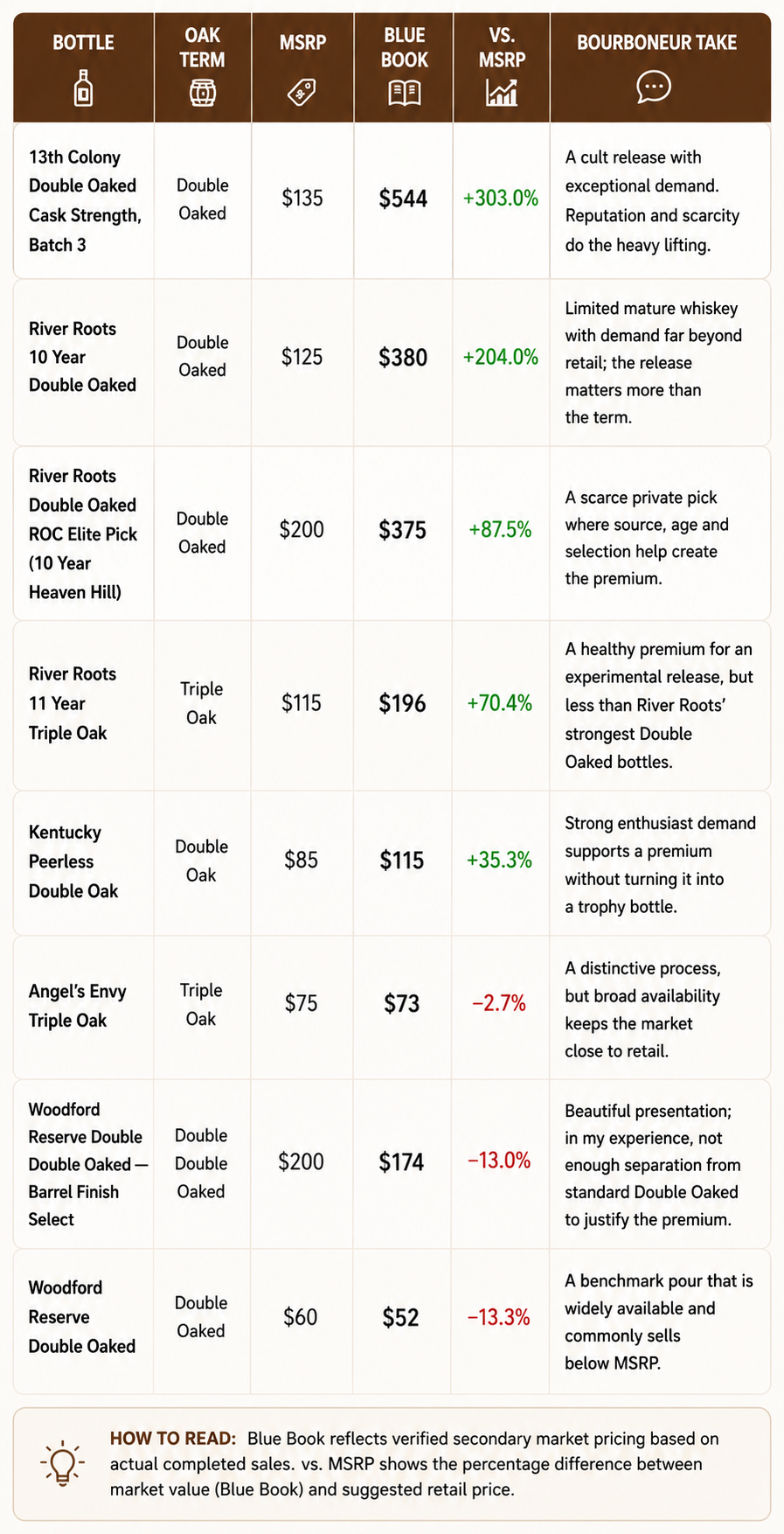
The most expensive bottle in the table is not Triple Oak. The largest premiums belong to 13th Colony and River Roots Double Oaked releases that have earned reputations as difficult-to-find, high-quality bottles. Their secondary values are not evidence of a universal “double oak premium.” They are evidence that collectors want those particular releases.
The other end of the table may be even more revealing. Angel’s Envy Triple Oak trades essentially at retail. Both Woodfords sit below MSRP, and their observed Total Wine pricing supports the same conclusion. Those bottles are not being rejected because of their oak treatment; they are simply available enough for the market to remain disciplined.
Peerless sits in the middle. Its second-barrel process has developed a loyal following and supports a reasonable premium, but it has not become a scarcity-driven trophy bottle. River Roots 11 Year Triple Oak also commands a meaningful premium, yet it trails the brand’s most coveted Double Oaked offerings. More oak does not create a predictable ladder of value, even within the same producer.
A second or third oak influence can make whiskey richer, sweeter and more layered. It can also make it dry, bitter or overly tannic. The result depends on the whiskey entering the finishing barrel, the wood, the toast and char, the climate, the proof and—perhaps most important—the amount of time the producer allows the two to work together.
That is why the number on the label should never function as a quality score. Triple Oak is not automatically more complex than Double Oaked. Double Double Oaked is not automatically twice as good as Double Oaked. These phrases describe a production story. They do not settle whether the bourbon is balanced, whether you will enjoy it or whether the bottle is worth its price.
The best examples earn their reputation in the glass. The most valuable examples add scarcity and collector demand. Sometimes those are the same bottle. Often they are not.
Bourbon has always had rules, but its modern oak vocabulary leaves producers plenty of room to experiment. That creativity has given us some outstanding whiskey—and some labels that require more explanation than the front of a bottle can provide.
The lesson is not to ignore Double Oaked, Triple Oak or Double Double Oaked. It is to ask what the producer actually did. How many barrels were involved? Were they new, used or rejuvenated? Were the components finished separately and blended? How long did the additional maturation last? Those answers tell you far more than the headline term.
And when the question shifts from how the whiskey was made to what the bottle is worth, the label becomes even less reliable. The Bourbon Blue Book shows no automatic premium for more oak. It shows something more useful: what buyers are actually willing to pay for each specific release.
The Bottom Line: The front label explains the whiskey’s story. The Bourbon Blue Book explains the market. They are both useful—but they answer very different questions.
A bottle’s oak story can explain how it was made. It cannot tell you whether $75, $200 or $500 is a fair price. The Bourbon Blue Book® tracks verified secondary market transactions across more than 12,000 bottles, giving you current values, market trends and the context to know the price before you pay it.
.png)

Data Matters. Get Whiskey Wise.™


.png)
.png)
0 Comments