.png)
American white oak may be the bourbon standard, but distillers are increasingly exploring trees from France, Hungary, Japan, Mongolia and beyond. Here is what changes when the wood changes.
Mashbills receive plenty of attention. Bourbon enthusiasts debate yeast strains, entry proof, warehouse location, age and proof with the intensity of scientists comparing laboratory results.
The barrel, meanwhile, is sometimes reduced to a single line: aged in new charred oak.
That description may satisfy the legal definition, but it barely begins to explain what is happening. The barrel is not simply a container. It is an active ingredient—one responsible for much of the color, aroma, texture and flavor ultimately found in the glass.
American white oak remains the foundation of bourbon, but a growing number of releases are making the species, origin and construction of the barrel part of the story. Buffalo Trace has explored oak from several continents through Old Charter Oak and its Experimental Collection. A. Smith Bowman built an Oak Series around American, French and Hungarian barrels. Bardstown Bourbon Company has introduced finishes involving centuries-old French oak, Oregon white oak and Japanese Mizunara.
Some of these names describe a distinct species. Others describe where the tree grew. Still others have less to do with taxonomy than grain, seasoning, barrel size or construction.
It is time to see the forest—and the individual trees—behind the barrel.
For a broader introduction to the subject, Bourboneur previously explored the overall impact of wood on bourbon. This time, we are going deeper—separating species from geography, cooperage choices and marketing language.
Oak possesses a particularly useful combination of strength, workability and chemical composition. Its wood can be shaped into curved staves, held together without glue and made sufficiently liquid-tight for years of maturation.
Just as importantly, oak contains compounds that interact with whiskey.
Heat breaks portions of the wood into flavor-producing components. Lignin can contribute vanillin and other aromatic compounds. Hemicellulose produces caramelized sugars. Tannins contribute structure, spice and dryness.
Charring creates a carbonized surface that can help remove or transform undesirable compounds. Immediately behind it sits what is commonly called the red layer, where heat has penetrated and transformed sugars within the stave. We previously took a closer look at that barrel anatomy in Deep Penetration: The Red Layer.
Temperature changes then push whiskey into the wood and draw it back out. Oxygen slowly enters through the barrel, supporting reactions that soften, combine and transform flavors over time.
Climate can accelerate that interaction—but faster does not automatically mean better. As explored in The Science of Whiskey Aging in a Warming World, extreme heat can increase extraction, evaporation and the risk of a whiskey becoming over-oaked before it becomes fully mature.
Before comparing species, it helps to separate several barrel variables that are often grouped together.
Different oak species contain different concentrations of tannins, vanillin and other extractable compounds. Their physical structures also vary, affecting how easily liquid moves through the wood.
Trees of the same species can grow differently depending on temperature, rainfall, soil and growing season. A slower-growing tree may develop tighter annual rings than the same species grown under different conditions.
This is why a geographic term such as Canadian oak can still be meaningful even when it does not identify a separate species.
Coarse-, medium- and fine-grain oak describe the spacing and structure of a tree’s growth rings. Grain influences the rate at which whiskey interacts with the wood, but it is not another species of oak.
After a tree is harvested and cut into staves, the wood may be seasoned outdoors for months or years. Sun, rain, fungi and time alter the raw wood before a barrel is ever assembled.
Toasting applies heat more gradually and can develop sugars, spice and aromatic compounds deeper in the wood. Charring creates the burned surface and carbon layer. Distillers can vary both processes to change what the barrel contributes.
Barrel capacity, stave thickness, the species used for the heads and even whether the wood previously held another liquid can influence the finished whiskey. A giant French oak barrel and a conventional 53-gallon French oak barrel may share a species while behaving very differently.
American white oak is the bourbon industry’s workhorse.
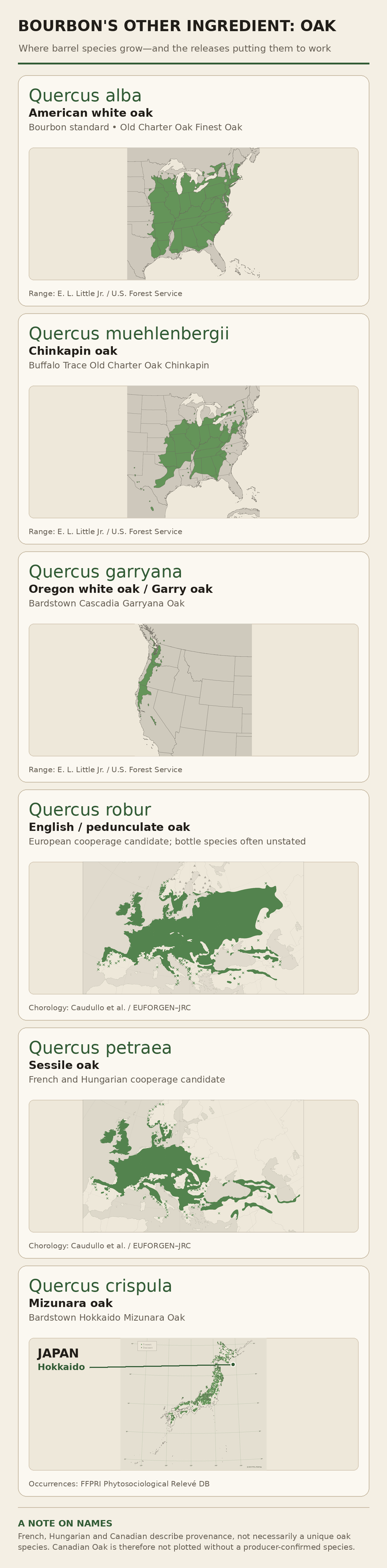
Its native distribution covers much of the eastern and central United States and extends into southern Canada. The species is strong, relatively abundant and particularly well suited to cooperage because structures known as tyloses help block the vessels running through the wood. That natural sealing ability makes Quercus alba an exceptionally practical barrel material.
Its familiar flavor contribution includes vanilla, caramel, toasted sugar, baking spice and the traditional woody character most drinkers associate with bourbon.
That familiarity does not mean every American white oak barrel behaves identically. Tree location, growth rate, grain, seasoning, stave selection, toast and char remain important.
Buffalo Trace’s latest Old Charter Oak expression, Finest Oak, illustrates that point. The barrels were made from selected American white oak, with staves hand-sorted by Canton Cooperage and open-air seasoned in Kentucky. The experiment is not built around discovering a new species. It asks what happens when familiar Quercus alba receives unusually selective preparation.
A. Smith Bowman approached American oak differently. Its Abraham Bowman Oak Series included whiskey aged for more than 12 years in charred American oak barrels and bottled at 135 proof. Here again, the species may be conventional, but its interaction with age, proof and barrel selection is not.
Chinkapin oak is a distinct North American species, not simply another name for American white oak.
Growing up in central Illinois, I would occasionally see Chinkapin oak growing near rivers and along limestone outcrops—sometimes in places that appeared to contain hardly any soil at all. Its coarsely toothed leaves look almost saw-like, making the tree relatively easy to distinguish once you know what you are looking for.
Those rocky, inhospitable conditions can also mean slow growth. Slower growth generally produces narrower annual rings and denser, tighter-grained wood—characteristics that may influence how whiskey moves through and extracts compounds from the barrel.
That does not mean every Chinkapin grows under identical conditions or develops the same grain. It does, however, provide useful biological context for why the species attracted Buffalo Trace’s attention.
Old Charter Oak Chinkapin was aged for nine years in barrels made from Quercus muehlenbergii. Buffalo Trace also subjected the staves to an extended seasoning period before barrel construction.
For enthusiasts, Chinkapin offers one of the cleaner examples of a true species experiment: a familiar Buffalo Trace mashbill and Kentucky maturation, but a materially different oak surrounding the whiskey.
I previously explored the tree, barrel and release more fully in this look at Old Charter Oak Chinkapin.
Oregon white oak—also known as Garry oak—is native to a relatively narrow band extending from California through Oregon and Washington into British Columbia.
Its limited distribution immediately separates it from the broad eastern range of American white oak. It is also difficult to source in meaningful quantities for cooperage.
Bardstown Bourbon Company’s Cascadia Garryana Oak Barrel Finish used custom barrels produced by Oregon Barrel Works. According to Bardstown, the barrels were made from Garry oak obtained through fallen trees and sanctioned cuts, then hand-toasted for three hours.
The whiskey began as a blend of three bourbons aged nine and ten years. It then spent ten months in ten custom Garryana barrels.
Bardstown chose sixth-floor summer aging to encourage greater interaction between the whiskey and the Garry oak. That decision matters because a finishing barrel does not operate independently of its environment. Temperature affects how aggressively the spirit moves into and out of the wood, reinforcing the relationship explored in The Science of Whiskey Aging in a Warming World.
This experiment demonstrates how many variables can move at once. The species changed, but so did the barrel source, toast profile, finishing period, warehouse location and whiskey blend. Any flavor difference cannot be attributed to taxonomy alone—but the unusual wood is unquestionably central to the release.
“French oak” is a geographic and cooperage description, not a scientific name.
Two important European species are pedunculate oak, Quercus robur, and sessile oak, Quercus petraea. Their natural ranges overlap across large portions of Europe, and both can enter French cooperage. Unless a producer identifies the species or forest source, “French oak” should not automatically be converted into a single Latin name.
French oak is generally associated with tighter grain, more tannin and flavors leaning toward baking spice, dark fruit and structured dryness. Those are useful tendencies—not guarantees.
Bardstown’s Cathedral French Oak Barrel Finish provides one of the more compelling recent examples. It used barrels made from approximately 300-year-old trees harvested from France’s Bercé Forest. The wood came from the same broader selection associated with the restoration of Notre-Dame Cathedral following the 2019 fire.
Only six barrels were reportedly produced. Bardstown filled them with a blend of five mature Kentucky bourbons ranging from nine to 18 years old and allowed the whiskey to finish for 14 months. The final release was bottled at 110.1 proof in a 375ml bottle.
The provenance, tiny production run and connection to Notre-Dame helped make Cathedral one of the most discussed releases of 2025. Whether its market value matched the whiskey inside the bottle was another question—one explored in Why Bardstown Cathedral French Oak Became the Most Hyped Whiskey Release of the Year.
Buffalo Trace has also investigated French oak repeatedly. Old Charter Oak French Oak made geography the headline, while the Experimental Collection compared barrels made entirely from French oak with barrels using American oak staves and French oak heads.
Those experiments help isolate an important question: how much of the barrel must change before the whiskey noticeably changes?
Hungarian oak presents the same naming challenge as French oak.
The term ordinarily refers to oak grown and harvested in Hungary rather than one exclusive species. Depending on the forest and supplier, the wood may involve Quercus petraea, Quercus robur or related European oak material.
The third release in the Abraham Bowman Oak Series used whiskey aged for 12 years entirely in Hungarian oak barrels. It followed the series’ French and American oak releases, creating a rare opportunity to examine three cooperage traditions within one limited collection.
The series also demonstrates why bottle labels require careful reading. American Oak points toward a familiar species more readily. French and Hungarian Oak initially tell us geography, but not necessarily the exact tree.
Mizunara is the Japanese oak most closely associated with luxury whisky. It is commonly identified as Quercus crispula, although older references and bottle descriptions may use Quercus mongolica var. crispula.
The tree grows in Japan, including Hokkaido, and has developed a nearly mythical reputation. Mizunara is slow-growing, porous and notoriously difficult to turn into leak-free barrels. The wood can twist or split, and mature trees suitable for cooperage are scarce.
Extended maturation is often associated with incense, sandalwood and aromatic spice, although Mizunara’s reputation can sometimes run ahead of what a brief finish can realistically deliver.
Bardstown’s Hokkaido Mizunara Oak Barrel Finish began with whiskeys aged between nine and 18 years and spent an additional 28 months in Japanese Mizunara barrels. It was bottled at 109.3 proof in a 375ml format.
That lengthy finish matters. Rare wood may create a compelling label, but the whiskey still requires enough interaction with that wood to make the experiment meaningful.
Mongolian oak is a distinct East Asian species with a natural distribution extending through portions of China, Korea and the Russian Far East.
It was also the first release in Buffalo Trace’s Old Charter Oak series. The name is more taxonomically informative than French, Hungarian or Canadian Oak because it points toward Quercus mongolica rather than geography alone.
It should not, however, be confused with Japanese Mizunara merely because the two trees are related and have sometimes been treated as botanical varieties within the same broader classification.
For the drinker, the important lesson is simpler: closely related trees can still develop under different climates, enter different cooperage traditions and produce barrels with meaningfully different physical characteristics.
Buffalo Trace identifies its Old Charter Spanish Oak as Quercus × hispanica, with staves harvested from northern Spain and seasoned outdoors.
The multiplication sign matters. It identifies a hybrid rather than a straightforward standalone species. The taxonomy and natural occurrence of Q. × hispanica are more complicated than a bottle label can reasonably explain.
For that reason, it should be presented carefully. “Spanish Oak” accurately describes Buffalo Trace’s release and stated wood source, but drawing a broad Spanish native range for the hybrid would imply a level of botanical certainty that may not exist.
This is exactly where marketing language, geography and taxonomy can begin to blur.
Old Charter Oak Canadian Oak was matured for ten years in barrels made from oak sourced in Canada. Buffalo Trace emphasized that the trees produced harder, tighter-grained wood, attributing those characteristics to their growing environment.
What Buffalo Trace does not clearly provide is a Latin species name.
Canadian-grown Quercus alba is a reasonable possibility because American white oak naturally extends into southern Ontario and Quebec. Canada also supports other native oak species. Without producer confirmation, however, assigning Old Charter Canadian Oak to Q. alba would convert an informed possibility into an unsupported fact.
The most accurate classification is therefore: "Canadian Oak: geographic provenance; species not publicly disclosed."
That does not make the experiment less interesting. In fact, it demonstrates why geography can matter even when the species remains unchanged: climate and growth rate can influence grain structure within the same type of tree.
Buffalo Trace’s Experimental Collection makes the distinction especially clear.
The distillery has tested fine-grain and coarse-grain oak, barrels with French oak heads, barrels made entirely from French oak and oversized 135-gallon French oak barrels. Its Single Oak Project went even further, following 96 individual American oak trees into 192 barrels while varying tree section, grain, seasoning, char, entry proof and warehouse placement.
“Giant French Oak” is not another species. Neither are “fine-grain oak” and “coarse-grain oak.” These releases investigate barrel construction and wood anatomy rather than taxonomy.
That may ultimately be more useful than a simple species comparison. Two barrels cut from the same type of tree can produce different results because of where the tree grew, which section of the trunk supplied the staves and how the cooper prepared them.
Not every modern barrel experiment involves another species of oak.
That distinction matters because bourbon must be stored in new charred oak containers. Alternative woods generally enter the process later—as finishing barrels, inserted staves or part of a hybrid barrel—rather than replacing the original bourbon barrel.
Cherrywood can contribute fruit, sweetness and aromatic spice, but it lacks some of the structural characteristics that make oak so effective for long-term maturation.
The recently released Blue Note Cherry Wood Cask provides a timely example. The whiskey was first aged in American oak and then finished in casks made from sustainably harvested wild-cherry wood sourced from the Jura region of eastern France.
The limited release uses a mashbill of 70% corn, 21% rye and 9% malted barley. It was bottled unfiltered at cask strength—120 proof—and carries a suggested retail price of $64.99 for a 750ml bottle. Approximately 1,000 cases were released.
Blue Note describes the finishing influence in terms of vibrant cherry, warm spice, gentle sweetness and toasted notes. While those flavors fit naturally with the story behind the wood, the important distinction is that the whiskey completed its qualifying maturation in new charred oak before entering the cherrywood casks.
Bardstown Bourbon Company has taken a different approach through hybrid toasted cherrywood-and-oak barrels. In that construction, oak retains a structural role while cherrywood introduces another flavor source.
Neither example places cherrywood on the oak family tree. Instead, they demonstrate two ways an alternative hardwood can be introduced after—or alongside—the barrel material traditionally associated with bourbon.
The exact cherry species used by Blue Note is not publicly identified beyond “wild cherry,” so assigning a Latin name would go beyond the producer’s disclosed information.
Amburana is a South American hardwood that has become increasingly visible in American whiskey finishing.
Its influence can be remarkably assertive. Cinnamon, baking spice, vanilla, toasted nuts and fragrant herbal notes are frequently associated with Amburana-finished whiskey. Even a relatively short finishing period can dominate the underlying spirit, making careful monitoring particularly important.
Amburana is not oak, and an Amburana barrel cannot serve as the original new charred oak container required to produce bourbon. It can, however, be used after bourbon qualification to create a finished American whiskey with a dramatically different profile.
Oak alternatives such as cherrywood and Amburana expand the flavor vocabulary of whiskey. They also reinforce the central lesson of barrel experimentation: changing the wood can transform the spirit—but not every wood belongs in the same legal or botanical category.
An unusual barrel can make a whiskey interesting. It does not automatically make the bottle valuable.
Wood can contribute to scarcity. Garry oak is difficult to source. Mature Mizunara suitable for cooperage is limited. Bardstown reportedly produced only six Cathedral French Oak barrels. Those constraints create real differences in production volume and cost.
But collectors do not value wood in isolation. Brand strength, reviews, distribution, bottle count and market timing may matter just as much.
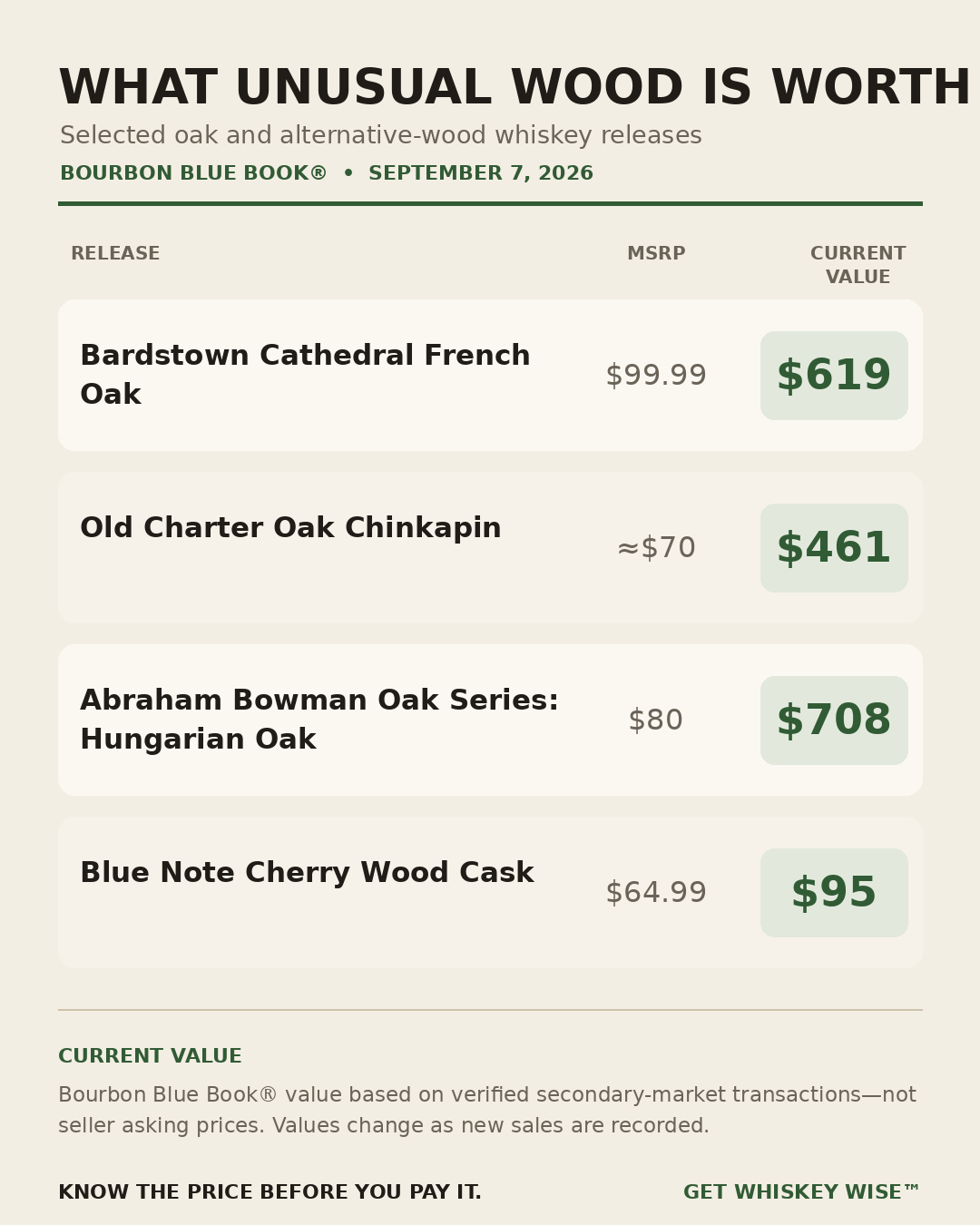
An exotic species, centuries-old tree or rare finishing barrel may explain why a bottle commands attention. It does not tell you whether the asking price is reasonable.
That is where the Bourbon Blue Book becomes useful.
Changing the wood can change the whiskey—but the species name does not tell the entire story.
A barrel reflects the tree’s biology, its growing environment, the section of the trunk selected by the cooper, the duration of seasoning, toast, char, construction and years of interaction with the spirit. Change any one of those variables and the result may change with it.
That is what makes today’s wood-focused releases so interesting. They are not merely replacing American white oak with something more exotic. They are revealing how much complexity has always been hidden inside the word barrel.
The wood can tell you how the whiskey was made. It cannot tell you what the bottle is worth.
The Bourbon Blue Book tracks more than 12,000 bottles using verified secondary-market transactions—not seller asking prices.
Use the Bourboneur app to check current value, compare average-low and average-high pricing, follow market movement, evaluate a trade and track the value of your collection.
.png)


.png)
.png)
0 Comments