.png)
In a rare moment of agreement across the bourbon community, collectors, retailers, traders and anonymous Facebook experts have confirmed that every bourbon price currently listed is wrong.
Prices are too high when someone wants to buy a bottle, too low when they already own it and completely meaningless whenever the latest transaction fails to support an argument they have already made.
“This market is completely detached from reality,” explained one collector while offering a bottle for $75 more than its recent average. “You have to understand—mine has a really clean label.”
Experts say the bourbon bubble has officially burst, although the collapse appears to be highly selective.
Every bottle a collector wants to purchase is expected to fall another 30 percent. Every bottle already sitting on that collector’s shelf is merely experiencing a temporary pricing imbalance caused by uninformed buyers, suspicious transactions and people who simply do not understand what they have.
One local enthusiast recently declared the entire bourbon market dead after seeing a bottle he owned sell for $12 below its previous average.
Asked whether he intended to sell his collection before prices fell further, he appeared confused. “Why would I sell now?” he responded. “These are long-term holds.” He later clarified that bourbon is meant to be opened and enjoyed.
None of his 286 bottles are currently open.
The bourbon community has long understood that an asking price does not establish market value. A bottle listed for $500 is not necessarily worth $500. It only means someone would like to receive $500.
Researchers have, however, discovered an important exception: when the person discussing the asking price is also the person selling the bottle. In those instances, the asking price becomes a carefully researched reflection of scarcity, historical importance, label condition, long-term demand and what the last one “basically sold for.”
Interested buyers who provide recent comparable sales are encouraged to stop lowballing.\
Actual transactions remain an important component of bourbon pricing—provided they produce the correct answer.
A low sale can generally be dismissed as:
A high sale, meanwhile, immediately establishes a new floor.
If three bottles recently sold for $325, $330 and $340, the bottle is generally worth approximately $400.
The calculation is not currently taught at accredited business schools.
Many enthusiasts insist that no bourbon is worth more than its manufacturer’s suggested retail price.
This remains true until they successfully purchase an allocated bottle at MSRP.
At that point, the bottle’s value is determined by rarity, replacement cost, national demand and the fact that they woke up extremely early to get it.
“I would never pay secondary,” explained one collector who recently purchased six unwanted store picks and accumulated 14,000 loyalty points for the opportunity to buy a limited release.
“That’s a $150 bottle all day,” he added, referring to the bottle he purchased for $69.99 and had no intention of opening.
Researchers have also confirmed the existence of “trade value,” an advanced economic principle under which a bottle becomes more valuable when offered by its current owner.
Consider the following example:
Your bottle: Recent sales average $250
Their bottle: Recent sales average $250
Their proposed trade: Your bottle plus $75
The difference reflects several important market factors, including how badly you want their bottle and how little they care about yours.
When asked to explain the calculation, experienced traders advised newcomers that they would eventually understand.
The most recent transaction should ordinarily provide useful evidence of a bottle’s current value.
Unfortunately, determining whether it counts requires additional analysis.
If the latest sale is lower than expected, one transaction means nothing. Collectors must consider a wider range of sales, market conditions and longer-term trends.
If the latest sale is higher than expected, the market has officially moved.
Previous sales are now irrelevant.
Please update your spreadsheets accordingly.
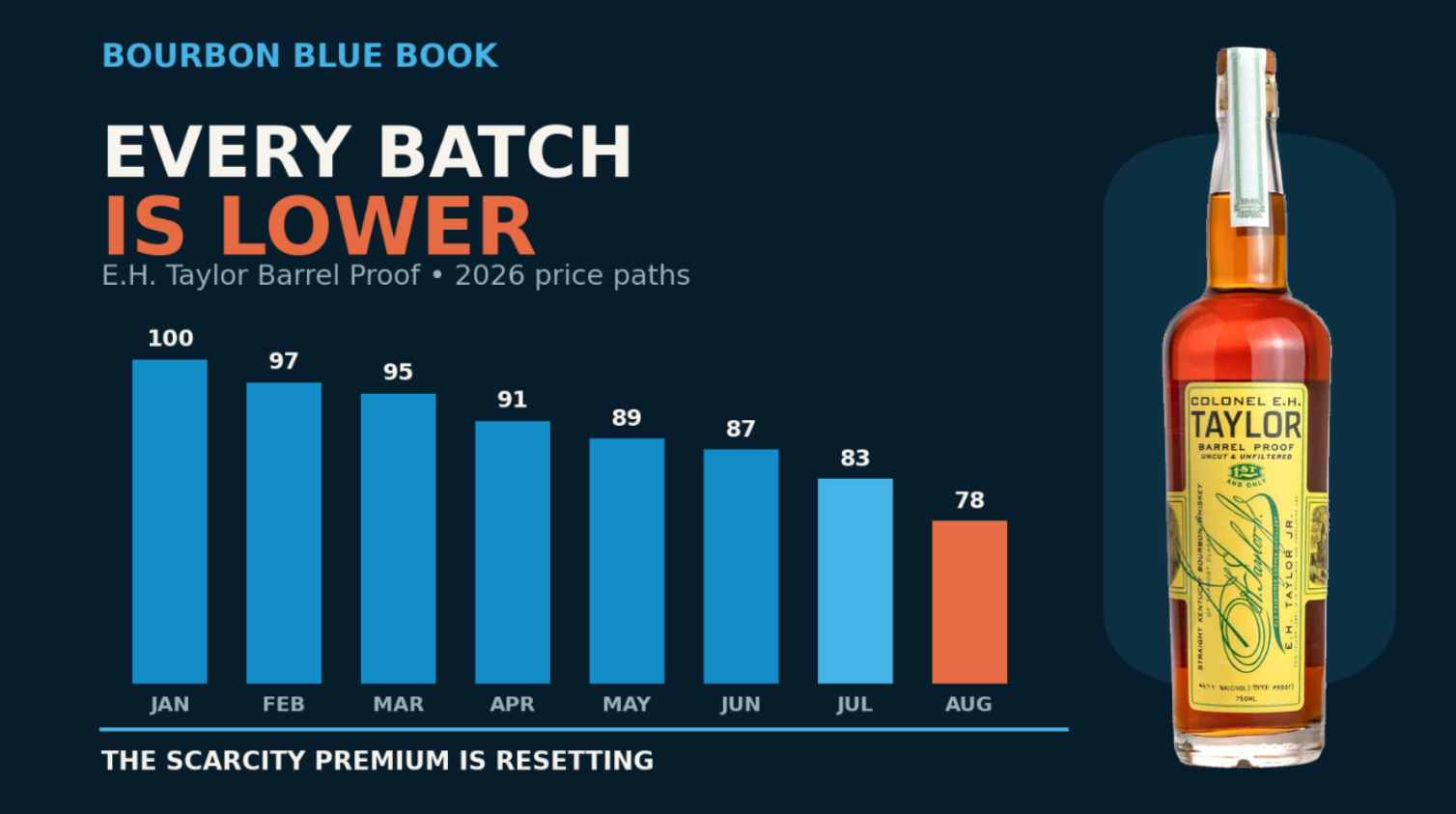
Behind the satire is a legitimate point: the bourbon market does not move as one.
Some bottles are experiencing meaningful corrections. Some brands have lost premiums established during a much hotter market. Certain new releases are taking longer to discover a sustainable price, while others continue to attract strong demand.
Some bottles are falling. Others are relatively stable. A smaller group may continue appreciating because of genuine scarcity, exceptional quality or renewed collector interest.
That makes sweeping declarations about “the bourbon market” difficult.
One discounted sale does not prove the entire bourbon bubble has burst. One record sale does not mean the boom has returned. Neither an asking price nor one collector’s Facebook feed can reliably define the value of thousands of different bottles.
Context matters.
So do actual transactions.
Every bourbon price will feel wrong to someone. Buyers naturally notice the lowest sale. Sellers remember the highest. Collectors treat gains as evidence of excellent judgment and declines as temporary market irrationality.
The market itself is less emotional.
A bourbon is not necessarily worth its MSRP simply because that was its original price. It is not worth the highest asking price currently posted. It is also not automatically worth whatever someone paid during the market’s peak. Its current value is best understood through actual sales, recent trends and enough context to determine whether an individual transaction represents the market—or merely happened within it.
You do not have to believe the bourbon bubble is bursting.
You do not have to believe it is recovering.
You just need to know what the bottles are actually doing.
The Bourbon Blue Book® tracks actual secondary-market transactions across more than 12,000 bottles, helping collectors understand current values and recent pricing trends before they buy, sell or trade.
Because every price may be wrong according to someone.
The data provides a much better place to start.
.png)


.png)
0 Comments