Bourbon Blue Book Insights • August 2026
Vacation-town liquor stores are rarely where bourbon hunters expect to find a bargain. Their shelves are more commonly associated with ambitious markups—allocated bottles displayed like trophies and priced for customers who may never return.
That made the cases of E.H. Taylor Barrel Proof sitting on the floor difficult to ignore.
This was not an old or unwanted expression. It was the latest release of one of Buffalo Trace’s most sought-after bourbons, available at just over retail price. Not at the multiples of retail that once defined the bottle’s secondary-market reputation. Not even at the prevailing secondary-market price. Cases of it were simply sitting there, available to anyone who walked in.
One store does not make a market. But sometimes an anecdote captures a change already visible in the data.
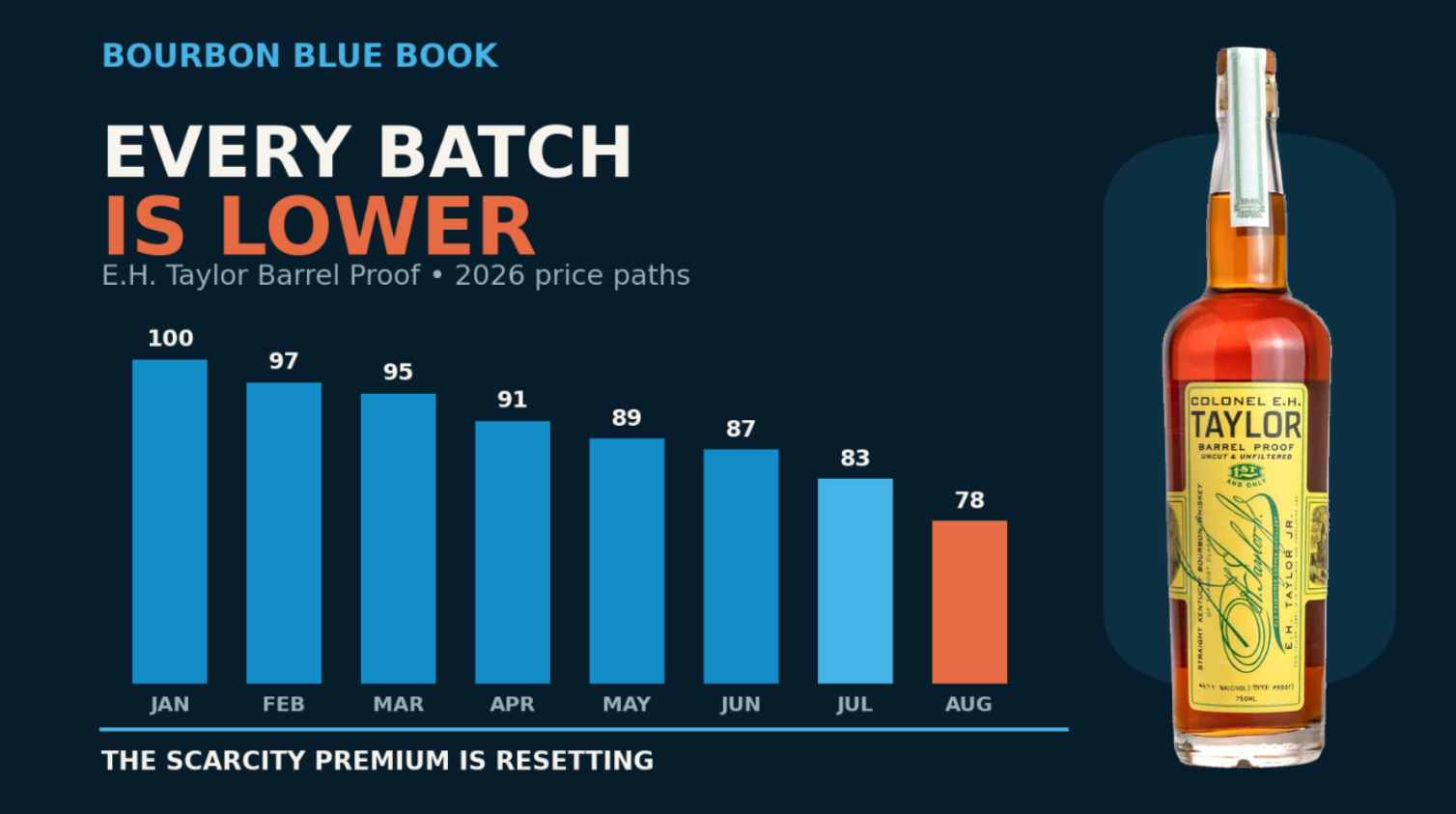
Through August 14, every E.H. Taylor Barrel Proof batch tracked by Bourbon Blue Book was lower in 2026. The median decline was 20.9%, while a value-weighted measure fell 16.4%.
The broader bourbon market did not experience anything comparable. Over the same period, the Bourboneur Secondary Market Index declined by approximately 0.7%. Barrel Proof was not merely participating in a general retreat. It underperformed the broader market by a wide margin.
That contrast matters because it changes the question. If bourbon prices generally had fallen by 15% or 20%, the weakness in E.H. Taylor might be unremarkable. Instead, a famously scarce Buffalo Trace release declined by double digits while the broader secondary market remained comparatively stable. Something specific was happening within the series.
For a closer look at the broader market’s 2026 path—from its January low through the spring recovery and subsequent return toward flat—read “The Bourbon Market Is Flat—But That’s Not the Whole Story.”
.png)
For most of its history, E.H. Taylor Barrel Proof settled into a rhythm collectors understood: roughly one batch per year. That cadence made each release feel singular. Buyers had one clear annual target, sellers had time to place bottles, and the market had months to absorb inventory before the cycle began again.
More recently, that rhythm tightened. Three closely related Barrel Proof batches were produced in 2025, followed by another new release in 2026. Public batch numbering is inconsistent—some market participants treat the 2025 bottles as separate batches, while others describe them as proof variants—but the economic point does not depend on the label. Buyers encountered several new opportunities over a much shorter period.
The Bourbon Blue Book histories show the spacing between first market observations compressing from almost eleven months to less than five months, then to less than four months. Two 2025 proof variants entered the tracked market together. A third followed before the earlier pair had fully settled, and the next release arrived only a few months after that.
We do not know the bottle count behind each release, so the data cannot prove how much total production increased. But collectibility depends on more than the number of bottles. It also depends on how quickly supply reaches the market.
.png)
The newest price histories look increasingly like rapid price discovery rather than durable scarcity premiums. Batch 13 entered the tracked data around $440. The first two 2025 variants appeared around $350 and $400, but both lost roughly half their value before the next variant entered the market. By then, all three 2025 proofs were valued within a few dollars of one another.
That convergence is revealing. Small proof differences initially created distinct listings and launch prices, but the market ultimately treated the bottles as close substitutes. The latest 2026 release opened around $225 and fell to roughly $130 in a little more than a month—a decline of more than 40%.
Opening prices are not the same as settled market values. Early observations can be thin, and the first sellers often test the upper limit of enthusiasm. Even with that caveat, the sequence shows buyers becoming less willing to preserve the initial premium. Each new release offered another reason to wait.
If the problem were limited to launch pricing, older batches might have remained insulated. They did not. Every tracked batch declined during 2026, including bottles released years before the recent change in cadence.
That is what we would expect when substitution expands. A collector considering an older batch is no longer comparing it only with one current release. Several newer proofs now compete for the same attention and budget. As their prices fall, they reset the reference point against which the rest of the series is judged.
The result is broader than a disappointing debut. New supply can pull down the back catalog when buyers no longer believe that every batch represents a singular, fleeting opportunity.
.png)
Scarcity is usually discussed as a question of quantity: How many bottles exist? In collectible markets, there is another dimension—how long buyers expect to wait for the next opportunity.
An annual release creates time scarcity. Passing on a bottle may mean waiting another year, watching the remaining inventory thin, or paying more later. Closely spaced releases change that calculation. Buyers can become more selective because another opportunity appears likely to arrive before long.
That does not mean E.H. Taylor Barrel Proof has stopped being desirable. Nor does it mean Buffalo Trace has damaged the whiskey itself. It means the market may be separating enthusiasm for the bottle from the scarcity premium that accumulated around it.
For drinkers, that could be healthy. A highly regarded barrel-proof bourbon available near retail is not a failed product; it is a bottle becoming accessible on different terms. For collectors and sellers, however, the lesson is more difficult: a premium built around annual scarcity can reset quickly when the annual rhythm disappears.
The cases sitting in that vacation-town store were only one scene. The price histories supply the larger evidence. Together, they suggest that E.H. Taylor Barrel Proof is not simply being carried lower by the bourbon market. It is being repriced for a market in which the next release no longer feels a year away.
Track the Bourboneur Secondary Market Index, monitor your collection, and check current secondary values in the Bourboneur app before your next buy or trade.
.png)


.png)
.png)
.png)
0 Comments