.png)
Something interesting is happening in bourbon—and it is coming in a smaller bottle.
Old Forester recently released Triple Char as the latest entry in its 117 Series. Four Roses announced a honey-cask-finished bourbon for its Experimental Series. Angel’s Envy unveiled a new bourbon finished in imperial stout and amburana wood. Still Austin released Rare Stock #8, an eight-year-old whiskey made entirely from wheat.
Different brands. Different whiskey. One increasingly familiar detail: each comes in a 375ml bottle.
The half-bottle was once an overlooked format most commonly associated with inexpensive whiskey, hotel minibars, gift sets and the occasional impulse purchase. Today, it is becoming something very different. For a growing number of distilleries, 375ml has become the preferred format for experimental, highly limited and often highly sought-after whiskey.
There is a reasonable argument for it. Smaller bottles allow distilleries to stretch limited stocks across more customers. They lower the initial cost of trying something unusual. They also give whiskey enthusiasts access to releases that might never make economic sense as full-size products.
But there is another side to the equation.
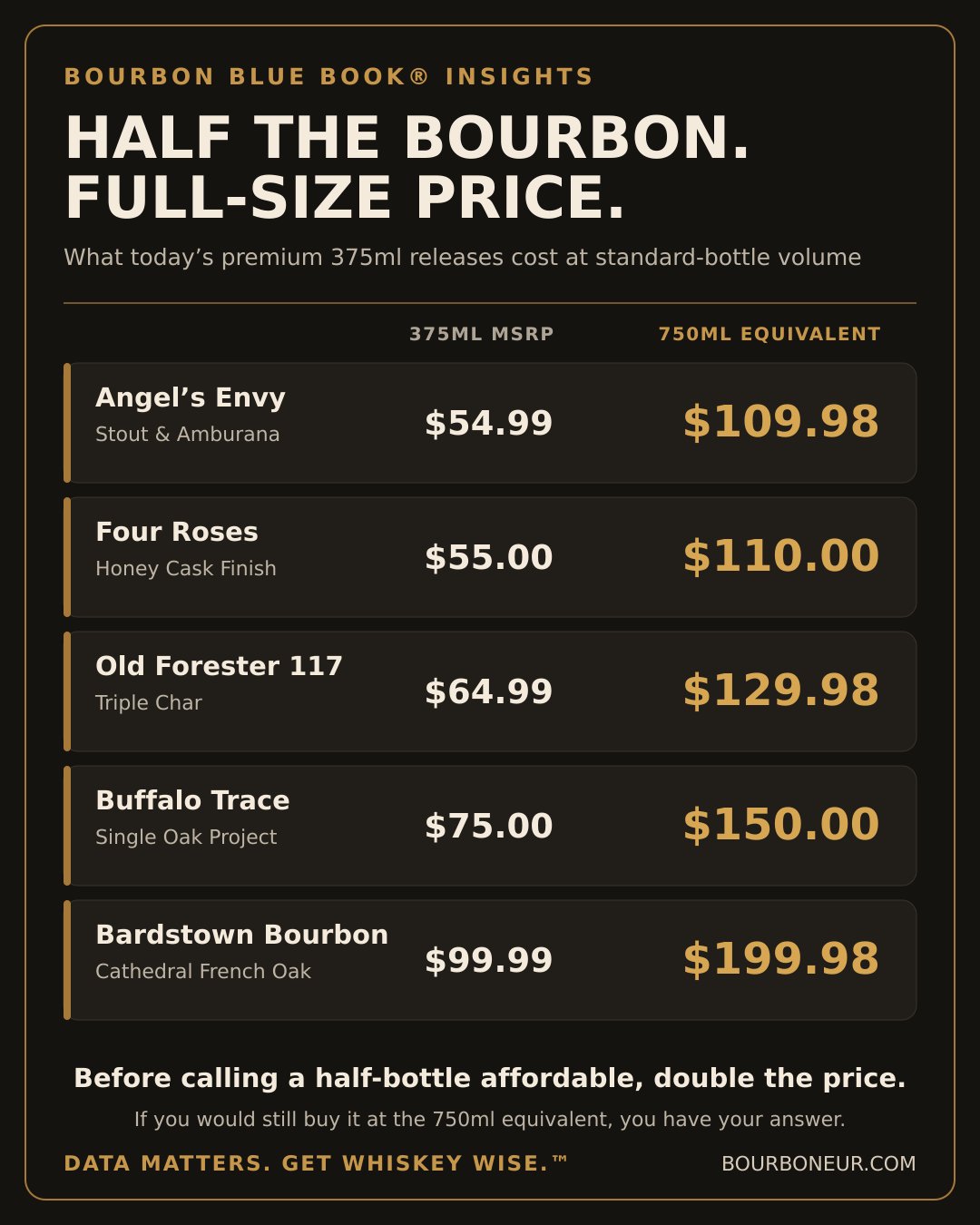
A $55 half-bottle does not represent a $55 bourbon. On a volume-adjusted basis, it represents a $110 bourbon.
And the bourbon industry seems increasingly comfortable betting that buyers will focus on the first number.
None of these releases is ordinary.
Old Forester’s 117 Series has become an outlet for exploring different parts of the brand’s whiskey-making process. The latest release, Triple Char, uses three different levels of barrel char and carries a suggested retail price of $64.99 for 375ml.
Four Roses Experimental Series No. 002 takes bourbon produced from its OBSV recipe and finishes it in honey casks. It will be sold in 375ml bottles for $55.
Angel’s Envy’s 2026 Distillery Series combines bourbon finished in imperial stout barrels with a much smaller amount finished in amburana wood. Approximately 18,000 bottles will be released exclusively through the distillery at $54.99 each.
Still Austin has built its Rare Stock series around 375ml releases featuring unusual mash bills and production techniques. Rare Stock #8 is an eight-year-old, 100% wheat whiskey—an especially mature release by Texas whiskey standards.
Bardstown Bourbon Company has also used the format throughout its Distillery Reserve series. One of its most recognizable examples, Cathedral French Oak, combined bourbons ranging from nine to 18 years old before finishing the blend in barrels made from centuries-old French oak. The retail price was $99.99.
Each release offers a legitimate point of distinction. These are not standard products poured into smaller bottles. They are precisely the kinds of limited experiments that make bourbon interesting.
They are also more expensive than their sticker prices initially suggest.
Looked at this way, the conversation changes.
Old Forester Triple Char is not really competing with the other bourbons sitting near $65. Its volume-adjusted price puts it alongside bottles costing approximately $130.
Cathedral French Oak did not enter the market as a $100 bourbon. It entered as the equivalent of a $200 bourbon—and secondary-market demand pushed its effective price considerably higher.
That does not automatically make either bottle overpriced. It simply provides the context needed to evaluate what you are actually buying.
Experimental whiskey is often produced in extremely limited quantities. A distillery may have only a handful of barrels available, particularly when it is working with older stocks, unusual grains or secondary maturation.
Putting that whiskey into 375ml bottles effectively doubles the number of bottles available compared with using the standard 750ml format.
That matters.
More bottles mean more customers can participate in a release. More collectors can add it to their shelves. More people can taste it, review it and share it online. A small experiment can create a much larger footprint without requiring another drop of whiskey.
The format also lowers the psychological barrier at checkout.
There is a meaningful difference between asking someone to spend $55 and asking them to spend $110—even when both purchases carry exactly the same price per ounce. The first can feel like an easy release-day decision. The second feels like a premium-whiskey purchase requiring considerably more thought.
That lower sticker price makes experimentation easier for the producer and the consumer. It also makes premium pricing easier to overlook.
The 375ml format is not inherently bad for whiskey drinkers.
In fact, there is a strong argument that bourbon could benefit from more small-format bottles. Most enthusiasts will never finish every bottle they purchase, particularly as collections grow. A half-bottle still contains roughly eight standard pours, which is more than enough to experience a whiskey multiple times and share it with a few friends.
The format also reduces the financial risk of trying something unconventional.
Amburana can be intensely polarizing. Honey casks, unusual grains and aggressive wood treatments will not appeal to everyone. Spending $55 to explore an experiment may be far more reasonable than spending $110 for twice as much of something you may not enjoy.
For extremely limited releases, smaller bottles can also spread the available whiskey across a larger number of buyers. If a distillery can fill 147 standard bottles or 294 half-bottles, as was the case for Still Austin's Rare Stock #8, the latter at least creates the possibility of twice as many people acquiring one.
Those are real benefits.
The problem is not the smaller bottle. The problem is evaluating it as though it were a full one.
The shift to 375ml has not necessarily made these releases easy to obtain.
Many are available only at the distillery. Others are released through tightly controlled allocations, online drops or limited geographic distribution. Collectible series encourage buyers to pursue every installment, while small production runs create the urgency that fuels release-day lines and immediate secondary-market activity.
I was in Austin when Still Austin Rare Stock #8 was released and forgo standing in line, with a substantial crowd camping out well before the distillery opened. Bardstown Cathedral French Oak became one of the most discussed releases of 2025, despite—and perhaps partly because of—its half-bottle presentation. Old Forester’s 117 Series has developed a cult following across multiple limited releases using the same format.
The smaller bottle may increase the number produced, but it can also increase the number of people chasing one.
That combination is powerful: an experimental product, an approachable-looking price, a collectible series and just enough scarcity to create urgency.
A 375ml bottle can still be a great purchase. The whiskey may be exceptional. Its age, rarity or production costs may justify the premium. The smaller format might even be preferable if you value variety over volume.
But the smartest way to evaluate it is to double the price.
Before buying a $55 half-bottle, ask whether you would still want it at $110 for 750ml. Before calling a $65 release affordable, consider how it compares with the full-size bourbons available around $130. Before spending $100, recognize that you are valuing the whiskey at approximately $200 per standard bottle.
If the whiskey still makes sense at that price, buy it and enjoy it. If doubling the number changes your opinion, the bottle size may have been doing more work than the whiskey.
The 375ml format is giving distilleries an exciting place to experiment. It is giving enthusiasts access to unusual whiskey without requiring a full-bottle commitment. There is plenty to like about that.
Just remember: half the bourbon does not always mean half the price.
And increasingly, it means a full-size price hiding inside a smaller bottle.
Whether a bottle contains 375ml or 750ml, value depends on more than its suggested retail price. Bourbon Blue Book® uses verified secondary-market transactions to help you understand what bottles are actually selling for—not simply what someone is asking.
Explore pricing, follow market movement and evaluate your next purchase with the Bourboneur app.
.png)


.png)
0 Comments