.png)
When Four Roses announced the Anthology Collection, it immediately felt different from the annual Limited Edition releases collectors have come to expect.
Rather than introducing another one-off bottle, Four Roses unveiled the first chapter in what is expected to become a decade-long series celebrating milestones throughout the distillery's history. Chapter One, appropriately named Origin, commemorates the founding of Four Roses in 1888 with the oldest bourbon the distillery has ever released—a 21-year-old OBSF Single Barrel bottled at barrel proof.
It's an ambitious concept. Over the next ten years, collectors will have the opportunity to assemble a complete Anthology Collection, one chapter at a time. Whether the series ultimately becomes one of bourbon's most sought-after modern collections remains to be seen, but there's little doubt that Chapter One immediately captured the attention of enthusiasts.
As bottles reached the secondary market, prices followed almost instantly. That wasn't surprising. What was surprising was how quickly values began to diverge.
Collectors looking at Facebook groups, private sales, and trade discussions were met with a confusing picture. One bottle might sell for just under $1,000, while another changed hands for $1,500. Even average values between individual barrels quickly began separating.
For a release that had only been available for days, one question kept coming up.
What's a fair price?
The reality is that the market doesn't know yet.
Every collectible goes through a period of uncertainty before its market value becomes widely understood.
Whether it's a rare baseball card, a vintage watch, a work of art, or a newly released bourbon, buyers and sellers spend the early days testing the market. Some sellers price aggressively, hoping excitement outweighs caution. Others simply want a quick sale. Buyers, meanwhile, are trying to decide whether paying today's premium will look like a bargain or a mistake six months from now.
Economists refer to this process as price discovery.
It's the period where repeated transactions gradually establish consensus around value.
Most allocated bourbons have already completed that journey. Bottles like George T. Stagg, William Larue Weller, and Pappy Van Winkle have years of market history behind them. Prices still fluctuate, but collectors generally have a reasonable understanding of where fair value sits.
Four Roses Anthology Chapter One hasn't reached that point.
In fact, it's still in one of the most interesting stages of its lifecycle. Every completed transaction helps shape the market's understanding of value, but the picture remains incomplete. That's why early releases often produce some of the widest pricing swings you'll ever see.
It's also why asking prices can be so misleading.
An asking price reflects what someone hopes to receive.
A completed transaction reflects what two collectors actually agreed the bottle was worth.
Those aren't always the same thing.
One of the more fascinating aspects of Chapter One is that collectors aren't simply buying "the Anthology bottle."
They're buying one of twenty-some individual single barrels, each bottled at its natural proof. While proof appears to influence pricing, it certainly isn't telling the entire story.
The Bourbon Blue Book is already tracking completed secondary transactions across the various barrels, and the early data paints a picture of a market that is still searching for equilibrium.
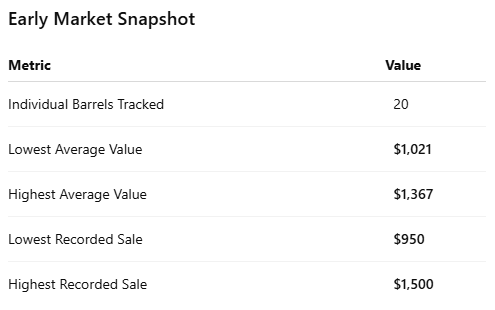
A $550 spread between completed sales is substantial for any bourbon, particularly one that has only recently reached collectors. More telling is the difference in average values between individual barrels. The market has already created a gap of nearly $550 between the lowest and highest average-priced bottlings.
That doesn't necessarily mean one barrel is objectively better than another.
It simply tells us buyers haven't yet settled on where value belongs.
Some of the highest-proof barrels are commanding the strongest prices, exactly as many collectors would expect. The current market leader, Barrel 63-5C, carries the highest proof in the release at 62.5% ABV and currently averages $1,367.
At the same time, several mid-proof barrels are outperforming bottles with significantly higher proof, suggesting proof alone isn't driving demand.

Conversely, the least expensive barrel currently being tracked, 63-3O, averages $1,021 despite carrying only modestly less proof than several barrels commanding considerably higher values.
That's exactly what price discovery looks like.
The market isn't simply deciding what Four Roses Anthology Chapter One is worth. It's trying to determine what each individual barrel is worth, and those answers are still evolving with every transaction.
Looking at the earliest transaction data, it's easy to reach a simple conclusion: higher proof commands higher prices.
To some extent, that's true. The highest-proof barrel currently tracked, 63-5C at 62.5% ABV, also carries the highest average market value. That's hardly surprising. Barrel-proof enthusiasts have long gravitated toward the biggest proofs, and early buyers often use proof as a quick way to distinguish one barrel from another.
But the data also tells us something more interesting.
Several mid-proof barrels have already established themselves among the most valuable in the release, while another barrel above 62% ABV remains closer to the middle of the pack. If proof alone determined value, that wouldn't happen.
Instead, what we're seeing is something much more familiar to experienced collectors. When information is limited, buyers gravitate toward the metrics they can easily compare. Proof is one of those metrics. As more bottles are opened, reviewed, and discussed, those early assumptions often give way to something more meaningful.
Flavor has a way of finding its price.
History has shown this time and again. Bottles initially overlooked because of proof, age, or reputation have gone on to become collector favorites once enough people actually experienced them. Others that generated tremendous excitement at launch eventually settled back to earth as the market gained a better understanding of what was in the bottle.
There's no reason to believe Anthology Chapter One will be any different.
The market isn't just deciding what Four Roses Anthology is worth. It's deciding which individual barrels deserve to separate themselves from the rest, and that process is still unfolding.
For most collectors, price discovery isn't an economic theory. It's the difference between making a smart purchase and overpaying because everyone else is guessing.
Imagine two collectors searching for the same bottle. One sees a Facebook post asking $1,500 and assumes that's the going rate. Another finds a completed sale at $1,050 and believes the first seller is unrealistic. Both are looking at real numbers, yet neither tells the full story.
That's because asking prices and market value aren't the same thing.
An asking price reflects what one seller hopes to receive. Market value is established when buyers and sellers repeatedly agree on a price over time. Until enough transactions occur, those two numbers can be surprisingly far apart.
That's exactly where Anthology Chapter One sits today.
As more bottles change hands, the market will gradually become more efficient. Buyers will gain confidence, sellers will better understand demand, and prices will begin to converge. The wide spreads we're seeing today are a natural part of that process, not an indication that something is wrong with the market.
For collectors willing to be patient, price discovery often creates opportunity. It also creates risk. Paying too much early can take years to recover, while recognizing where the market is beginning to settle can make all the difference when deciding whether to buy, sell, or simply hold.
Every collectible bottle has a story.
Some are remembered for how quickly they appreciated. Others become famous because they never lived up to the hype. The only way to know the difference is to follow the market after the excitement fades.
That's why the Bourbon Blue Book focuses on actual secondary-market transactions rather than asking prices. Asking prices can be informative, but they don't establish market value. Completed sales do.
Anthology Chapter One is still in its earliest days. The market is working through the price discovery process one transaction at a time, and every sale adds another piece to the picture. A year from now, today's pricing may look remarkably accurate—or it may look like little more than the opening chapter in a much longer story.
Either way, the data will tell us.
As Four Roses releases the remaining Anthology chapters over the next decade, collectors won't just be watching for the next bottle. They'll be watching how the market values each chapter, each barrel, and ultimately the collection as a whole.
The Bourbon Blue Book will be there to track that journey, giving collectors something more valuable than opinions or asking prices: a transparent record of where the market has been, where it is today, and where it may be headed next. Download below for both iOS and Android.
.png)


.png)
.png)
.png)
0 Comments