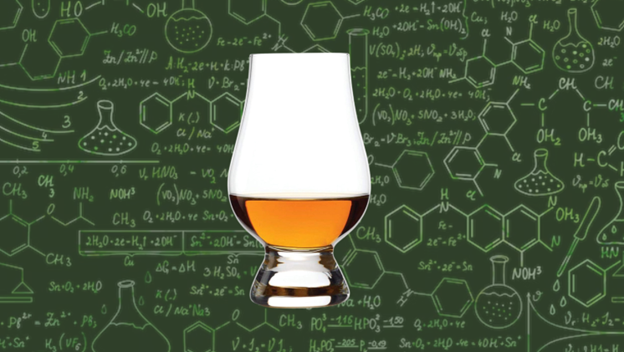
For years, the Glencairn glass has been treated as gospel in the whiskey world. If you’re serious about bourbon, you must be nosing from a Glencairn — or so the prevailing wisdom goes. Distilleries use them. Tasting rooms default to them. Influencers pose with them.
And yet… if you regularly drink high-proof bourbon — barrel proof, cask strength, hazmat-adjacent monsters — the Glencairn may actually be working against you.
This isn’t heresy for the sake of contrarianism. It’s physics, chemistry, and sensory science colliding with tradition. Let’s talk about why the Glencairn can amplify alcohol vapors to the point of diminishing returns — and why other glassware may offer a better experience for higher proof pours.
The Glencairn’s defining feature is its tapered bowl and narrow chimney. This shape was intentionally designed to:
• Concentrate volatile aromatic compounds
• Funnel aromas directly toward the nose
• Enhance perception of nuance in lower-proof spirits
For many whiskies — especially those bottled between 40–46% ABV (80–92 proof) — this works beautifully. Esters, aldehydes, phenols, and oak-derived compounds rise gently and remain distinguishable.
But high-proof bourbon doesn’t play by the same rules.
Ethanol is a highly volatile compound. As ABV increases, so does the vapor pressure of ethanol relative to other aromatic compounds.
Scientific studies on distilled spirits aroma perception consistently show that:
• Ethanol volatilizes faster than many flavor-active compounds
• High ethanol concentration suppresses perception of subtle aromas
• Ethanol vapor causes trigeminal nerve stimulation (the “burn”)
In plain English: alcohol yells, flavor whispers.
When you pour a 120–140 proof bourbon into a Glencairn, the narrow rim traps and channels ethanol vapor directly into your nose. The result is often:
• Sharp nasal burn
• Masking of esters and congeners
• Flattened or “hot” aroma profile
You’re not smelling more — you’re smelling less, dominated by ethanol.
Another overlooked issue is sensory adaptation. High ethanol exposure rapidly desensitizes olfactory receptors.
Research in sensory science shows that prolonged or intense exposure to ethanol vapor can:
• Reduce aroma discrimination
• Shorten effective nosing time
• Bias perception toward alcohol-forward notes
In practice, this means that after one or two aggressive nosings from a Glencairn, your nose is already tired. Subsequent nosing yields diminishing returns — everything starts to smell the same.
That’s not the bourbon’s fault. That’s the glass.
Counterintuitively, allowing ethanol to escape can improve aroma clarity.
Glasses with a wider opening:
• Disperse ethanol vapor laterally instead of vertically
• Reduce ethanol concentration at the nose
• Allow heavier aromatic compounds to remain perceptible
This aligns with gas diffusion principles: increasing surface area and exit pathways lowers localized vapor concentration.
Less alcohol assault = more room for caramel, fruit, spice, and oak to show up.
If you’re routinely drinking barrel proof bourbon, consider rotating your glassware based on proof.
1. Rocks Glass (Yes, Really)
A standard rocks glass may not look fancy, but it excels at:
• Letting ethanol dissipate
• Encouraging slower, more relaxed nosing
• Reducing nasal burn
For bourbons north of 120 proof, this can be revelatory.
2. Canadian Glencairn / Wide-Mouth Tulip
A wider tulip-style glass keeps aroma structure without over-concentration. You still get directionality — just without ethanol overload.
3. Copita (With Caution)
Traditionally used for sherry and whisky evaluation, copitas can work if you nose gently and from a distance. For some, they strike the right balance.
The Glencairn isn’t bad. It’s just context-dependent.
• Lower proof bourbon? Glencairn shines
• High proof bourbon? It often exaggerates ethanol at the expense of nuance
At Bourboneur, the goal isn’t to follow ritual — it’s to maximize enjoyment and understanding of what’s in the glass. If a different vessel helps you taste more and burn less, that’s not breaking the rules. That is the rule.
Glassware is a tool, not a badge of seriousness.
And sometimes, the best way to appreciate a big, bold bourbon is to let it breathe — literally.
If 2025 taught us anything, it’s that the bourbon market doesn’t pause. Drop season is now year-round, bottles hit the secondary before receipts cool, and the gap between hype and heritage has never been wider.
Navigating that requires more than instinct—it requires truth in numbers. The same approach that recently earned Bourboneur recognition from Forbes.
That’s why we built the Bourbon Blue Book®. With live, verified secondary sales data on over 9,500 bottles, it exists to help you avoid overpaying for shelf noise—or missing the undervalued gems hiding in plain sight.
Inside the Bourboneur app, you get:
• Real-Time Market Data – No guesswork. Just what bottles are actually selling for.
• The Blue Book Advantage – At $3/month or $25/year, it pays for itself the first time you walk away from a bad deal.
• A Growing Community – Thousands of collectors using data—not hype—to stay Whiskey-Wise.
Whether you’re hunting a 16-year Old Commonwealth or pricing a fair trade, don’t fly blind in 2026.
📲 Download the app on iOS or Android.
📩 Subscribe below for our weekly insider email.
📷 Follow along on Instagram, Facebook, and TikTok.
That’s Bourboneur.
.png)


.png)
.png)
.png)
0 Comments