
Fall release season meets a softer secondary market
Bourboneur | Market data through October 12, 2026
Apparently, nobody told King of Kentucky that the bourbon market was supposed to be cooling off.
In our October 9 snapshot, the 2026 King of Kentucky 14 Year was finding buyers at observed secondary prices ranging from $1,675 to $2,150. Barrel 55, which yielded just 46 bottles, sat at the top of that range. Several other barrels were trading around $1,700.
Meanwhile, the Bourboneur Secondary Market Index (BSMI) was heading in the other direction. By October 12, it was down 2.34 percent for the year, having surrendered a spring recovery that took it to positive 2.02 percent in June.
A softer market. A bottle changing hands for more than two grand. With fall bringing attention back to BTAC, Pappy and other coveted releases, collectors have a fair question: where, exactly, is this cheaper bourbon everyone keeps talking about?
When we published our August market update, the BSMI stood just 0.57 percent below its starting point for 2026. The endpoint looked quiet. The journey had been anything but.
The index fell to negative 1.41 percent on January 30, recovered through spring and reached its year-to-date high of positive 2.02 percent on June 6. By early August, that gain was gone.
The slide continued. September ended at negative 2.18 percent, and October 8 brought a new year-to-date low of negative 2.36 percent. The latest reading, negative 2.34 percent, is only a fraction above that low.
That leaves the index approximately 4.27 percent below its June peak. This is a modest decline, but a meaningful change from a market that seemed to be regaining ground a few months ago. The recovery failed to hold.
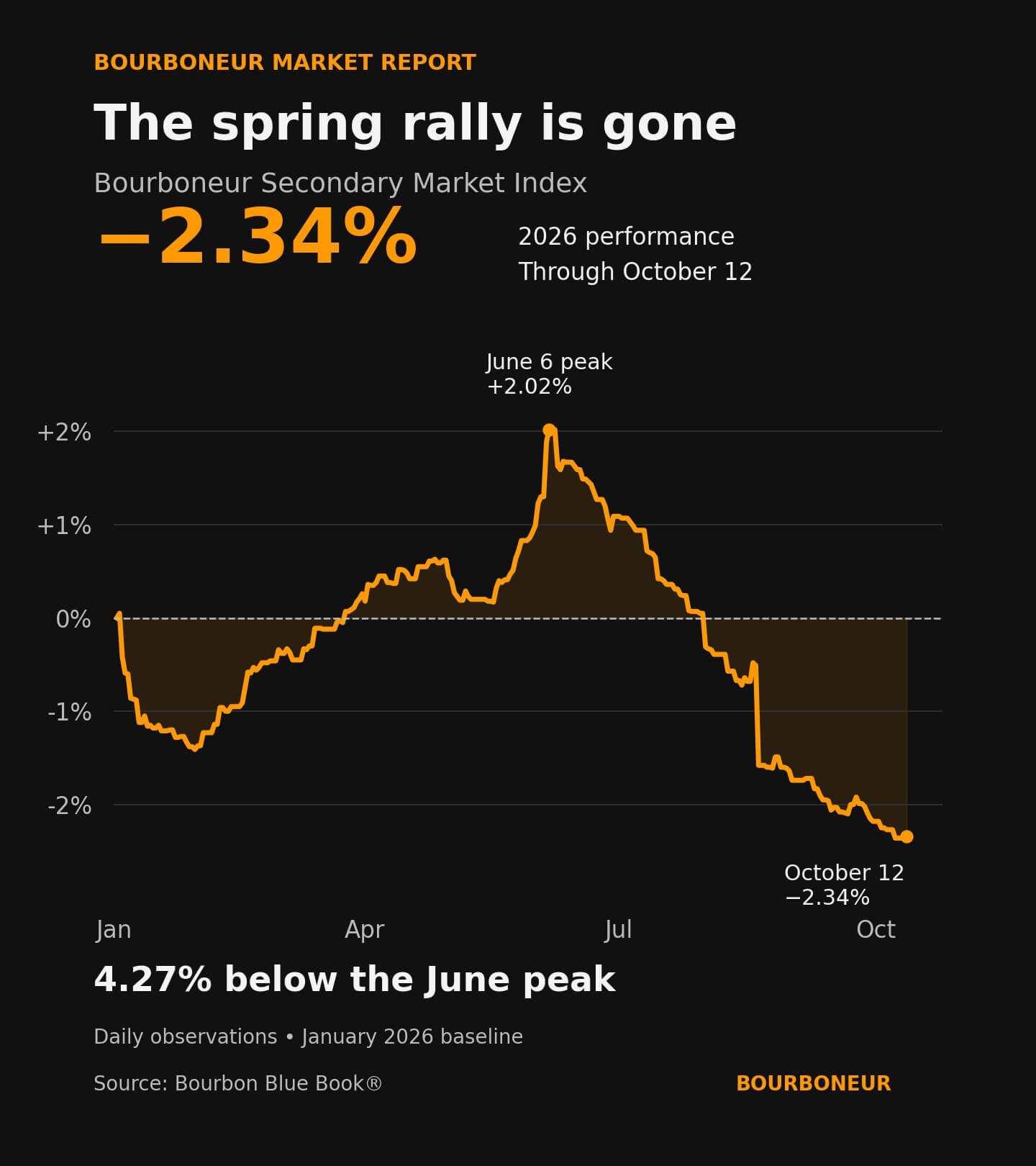
The BSMI tracks a curated basket of commonly traded collectible bourbon. It provides a consistent view of price movement across that basket. It does not promise that every bottle will move with it, and it is not a gauge of what someone will pay for the first newly released unicorn they can get their hands on.
A familiar bottle circulating throughout the year and a limited release arriving in its first wave face different buying conditions. Early availability can be thin. Attention can be intense. Buyers may have very little sales history for that particular release.
For annual releases such as BTAC and Pappy, the distinction runs within the label itself. Older editions already have an established resale history. The newest edition still has to find its price as bottles reach buyers and more transactions establish a range.
The price of owning it immediately can be different from the price it settles at later. Both can reflect actual sales. The first tells you what early access costs; the second tells you more about demand after the initial scramble.
Our early King of Kentucky snapshot shows that substantial spending on a particular coveted release can coexist with weakness in the broader basket. It gives us a current example of buyers accepting four-figure prices while the BSMI is near its lowest reading of the year.
Even within the release, prices differ. Barrel 55, with a yield of 46 bottles, was observed at $2,150. Barrel 43, with 108 bottles produced, was at $1,675. Bottle counts describe barrel yield, not the number of sales behind the price observations.
Those figures make barrel-specific scarcity worth examining. They do not establish that yield alone explains the difference. Proof, warehouse preference and the small number of bottles initially changing hands may also influence early pricing.
Just as importantly, an expensive sale is not evidence of appreciation. A bottle can find a buyer at $2,150 today and trade lower later. These are early prices in a developing market, not a verdict on where the release will settle.

The latest available BEA income and spending release offers a more complicated backdrop than a simple claim that consumers have stopped spending. In August, inflation-adjusted consumer spending increased 0.6 percent from July, while inflation-adjusted disposable income was unchanged. The personal saving rate was 4.1 percent, and PCE inflation was 3.4 percent over the preceding year.
Overall spending was still growing, even as real income made no progress that month. Those national figures do not tell us how bourbon collectors allocated their budgets, but they caution against treating a falling bourbon index as proof that buyers have disappeared.
Other collectible markets offer another useful reference. Liv-ex tracks secondary-market fine wine prices, and its current published tables show positive year-to-date performance for its Fine Wine 100 and broader Fine Wine 1000, alongside negative two-year performance. That is a reminder that recovery can vary between collectible categories. Different reporting dates, currencies and methodologies prevent a direct return comparison here.
Economic pressure may influence what collectors are willing to spend. It does not, by itself, explain why one bottle attracts a substantial premium while another loses ground.
As the fall lineup reaches collectors, the question is whether demand extends beyond the headline releases. Can enthusiasm help the established market regain ground, or will expensive new bottles coexist with continued weakness elsewhere?
King of Kentucky shows that buyers will still spend heavily on a specific release. It cannot establish how broad that appetite is. BTAC and Pappy will provide more opportunities to watch how opening prices evolve as availability expands.
The useful comparison is the same stage of the release cycle: the first weeks against the first weeks, and 60 or 90 days against the same period for prior editions. Comparing a fresh launch with last year’s settled price risks confusing an early access premium with stronger lasting demand.
Repeated sales matter, too. A handful of transactions can establish that a price has been paid. More activity is needed to understand how consistently buyers accept it.
A falling index is no guarantee that the bottle you want will become cheaper. An expensive opening sale is no guarantee that waiting will cost you more.
Before stretching for a new release, look at what comparable editions did after their first wave. Check whether the number in front of you is supported by transactions or merely an optimistic listing. Then decide how much owning it now is worth to you.
Paying extra to open a bottle with friends next weekend can be a perfectly understandable choice. Paying extra because you assume the price can only rise is a different proposition.
That is the practical lesson of this fall’s market: broad weakness and very expensive bottles can exist at the same time. The challenge is understanding the premium on the bottle you are actually buying.
The Bourbon Blue Book® helps you check current bottle values and price histories inside the Bourboneur app. Use the BSMI to understand the backdrop, then look at the individual bottle before deciding what deserves your money. Fall release season supplies plenty of excitement. A little price history belongs in the hunt, too.
.png)


.png)
.png)
0 Comments