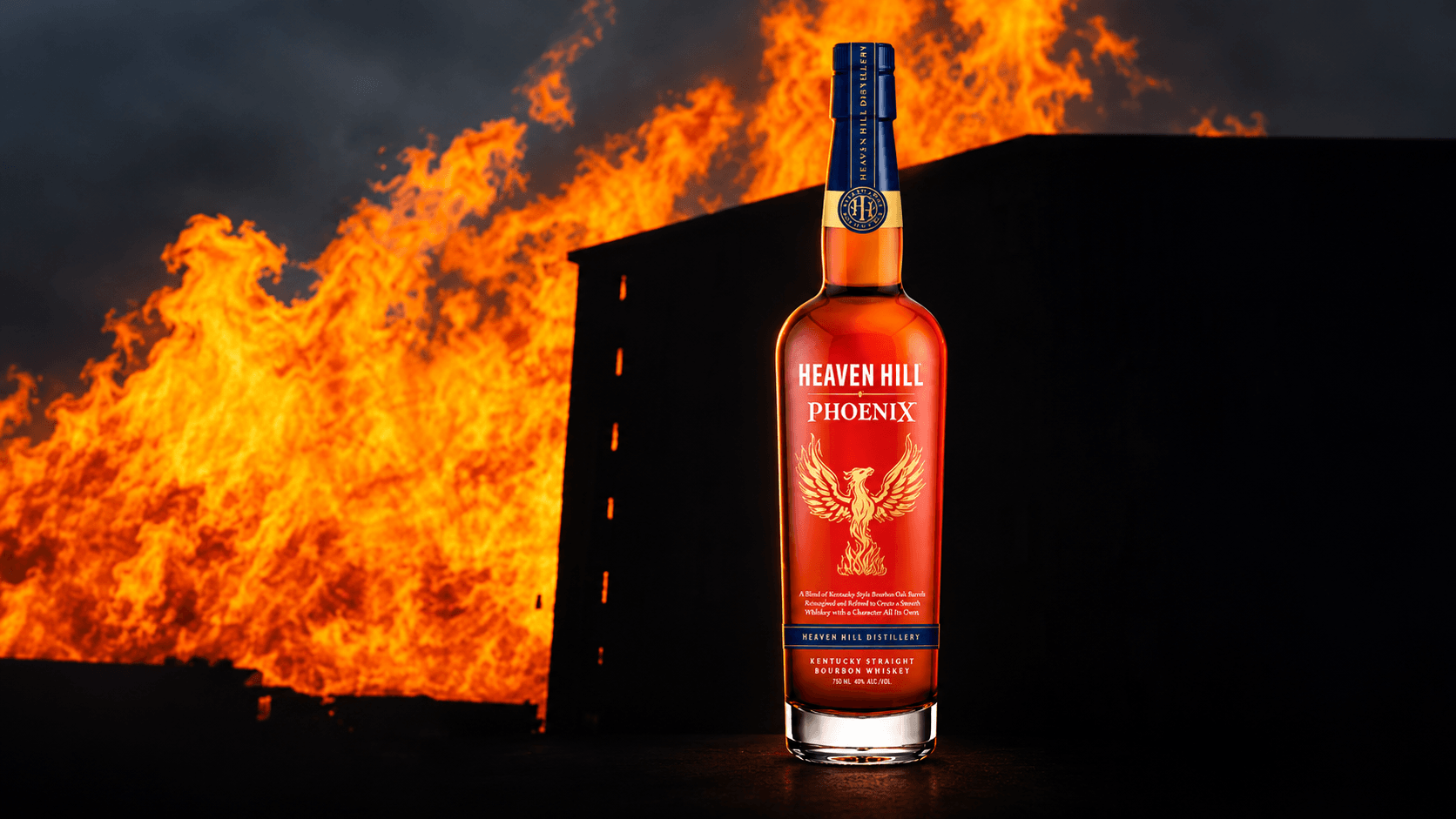
Bourbon collectors love a good origin story. Give us an age statement, a connection to a long-gone distillery, and a limited release, and suddenly we’re doing the kind of financial gymnastics that would concern anyone outside the hobby.
Heaven Hill Phoenix has all three.
The new release commemorates the 30th anniversary of the fire that destroyed Heaven Hill’s original Bardstown distillery. It combines 18-year-old bourbon with a portion of 30-year-old whiskey distilled at the original Old Heaven Hill Springs Distillery, bottled at 107 proof. It’s a one-time, limited-market offering with a direct connection to the company’s past.
That’s a compelling introduction. Then comes the price.
With a retail benchmark of approximately $325, Phoenix is already commanding a substantial premium. Early secondary-market transactions tracked by the Bourbon Blue Book® are averaging $1,121, with a $1,000 low and a $1,200 high as of October 18, 2026. That puts the average at roughly 3.45 times the retail benchmark.
There’s history in this bottle. The question is how much you’re willing to pay for it.
On November 7, 1996, a devastating fire destroyed Heaven Hill’s Bardstown distillery and seven rickhouses. Thirty years later, the company is commemorating that event with a November 7 celebration at the Heaven Hill Bourbon Experience, reflecting on the loss and the resilience that followed.
Phoenix gives that anniversary a bottle of its own.
Its connection to the past comes through the 30-year-old bourbon in the blend, which was distilled at the original facility. For collectors interested in production history, that provenance is part of the appeal. It offers a connection to a distillery that cannot produce another barrel.
But understanding that connection also requires understanding what’s actually in the bottle—and what the language describing it tells us.
“Mingled” sounds a little more romantic than “combined,” particularly when there’s 30-year-old bourbon involved.
In practical terms, it means whiskeys were brought together before bottling. Here, 18-year-old bourbon is combined with a portion of 30-year-old bourbon.
The ages don’t add together. The older whiskey doesn’t turn the entire batch into 30-year-old bourbon. And the word itself tells you nothing about the proportions.
The release is described as containing a “rare touch” of the older reserves, but the proportion has not been disclosed in the available product description. That leaves an important detail unanswered: how much 30-year-old bourbon is actually in the blend?
That doesn’t make the older component meaningless. A smaller portion of whiskey can still influence a blend. But without a disclosed proportion or firsthand tasting, we shouldn’t pretend to know how much it shapes the finished product.
You’re buying an 18-year-old bourbon with a 30-year-old component—not a 30-year-old bourbon.
At more than $1,100 on the secondary market, that distinction deserves more than a passing glance.
Against a retail benchmark of approximately $325, Phoenix’s current secondary average represents a premium of roughly $796.
That’s a substantial amount to pay for access.
It also separates two very different purchasing decisions. Someone buying Phoenix around $325 is evaluating an expensive, mature bourbon with a distinctive historical connection. Someone buying at $1,121 is making that same assessment with nearly $800 added to the bill.
The whiskey hasn’t changed between those transactions. The cost of obtaining it has.
Collectors may place real value on owning a commemorative release, particularly one connected to the original distillery. Others may simply want to open it and find out what Heaven Hill has put together. Both are understandable motivations.
But the fact that a bottle is desirable doesn’t settle what you should pay for it. As we explored in Bourbon Scarcity Is Changing. Shelf Prices Haven’t., availability, asking prices, and actual transactions can tell very different stories.
The current $1,000–$1,200 transaction range gives us an early look at what buyers are willing to spend. It does not establish where Phoenix will trade a month from now.
At launch, the people most determined to own a bottle are often the first to enter the market. Buyers willing to wait aren’t necessarily represented in those initial transactions.
As more bottles appear, we’ll get a better sense of whether demand supports these prices. The market could hold, climb, or soften. We don’t yet have enough history to call that direction with confidence.
That fits the question we examined in our fall bourbon market report: a softer broader market can still coexist with expensive new releases. The first price paid tells us what early access costs, not necessarily where a bottle will settle.
Historical significance can remain constant while the price changes considerably. The anniversary will still be the anniversary after the initial excitement passes.
For me, Phoenix is interesting because the history gives us something worth exploring. The connection to the original distillery adds substance to the release, and the older component raises useful questions about how the bourbon was assembled.
But that interest doesn’t automatically justify any asking price.
I haven’t tasted Phoenix, so I’m not going to tell you the whiskey earns—or fails to earn—its premium. What the available information does tell us is that buyers are already paying substantially above the retail benchmark, while the proportion of its oldest component remains undisclosed.
That’s a reason to be deliberate.
If you’re buying for the history, understand the history. If you’re buying for the whiskey, look for tasting perspectives that help you judge whether it fits your preferences. And if you’re buying because you think tomorrow’s price will be higher, recognize that you’re making a prediction.
Phoenix has a story worth telling. Whether that story belongs on your shelf at $1,121 is a separate decision.
Before you pay for the legend, know what’s in the bottle—and what the market is charging you to own it.
Check current bottle values and price histories in the Bourbon Blue Book, then track what you own in the Bourboneur app. A new release brings plenty of excitement. Bring a little market context with you.
Pricing reflects transactions tracked by the Bourbon Blue Book as of October 18, 2026. Market values can change as additional sales occur.
.png)


.png)
0 Comments