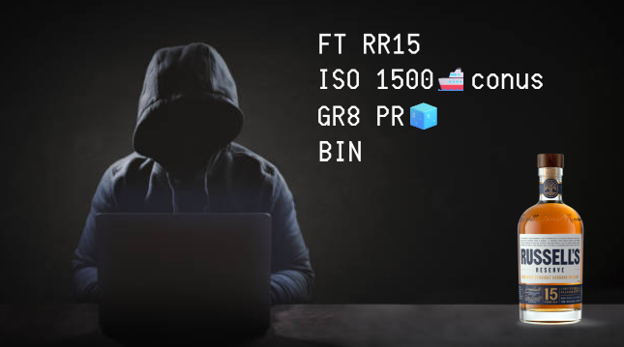
Few modern bourbon releases have captured the attention of collectors quite like Russell's Reserve 15.
Since its release in 2024, Russell's Reserve 15 has been one of the strongest performers on the secondary market, appreciating more than 130% according to Bourboneur tracking. Demand remains exceptionally strong, bottles continue changing hands regularly, and many collectors believe there is still room for further appreciation.
But recently, a different story began unfolding in several large secondary bourbon groups—one that highlights an important challenge facing collectors and pricing platforms alike.
Over the past several days, multiple listings appeared offering Russell's Reserve 15 at prices around $1,500 per bottle—significantly above recent market activity.
On the surface, this might seem like evidence that the market had suddenly moved higher. After all, if buyers are willing to pay it, isn't that the new market value?
Not necessarily.
In several instances, community members began noticing unusual patterns. Newly created profiles were posting bottles at elevated prices. Other recently created accounts would quickly comment "BIN" (Buy It Now), creating the appearance of an immediate sale. Supporting comments would often follow, suggesting the asking price was a bargain or signaling approval with the familiar " great pr🧊" comment, commonly (and rather annoyingly) used to indicate a strong deal - or bait someone into paying.
To an outside observer, it looked like Russell's Reserve 15 had suddenly jumped in value.
The problem? Market value is determined by legitimate transactions—not manufactured ones.
Whether you're talking about stocks, sports cards, sneakers, watches, NFTs, or bourbon, markets are heavily influenced by perception.
If collectors repeatedly see a bottle listed at $1,500 and apparently selling at $1,500, many will begin to anchor to that number. Future sellers raise their asks. Future buyers become more willing to pay higher prices. Over time, perception can begin influencing reality.
The process is surprisingly simple:
1. List a bottle significantly above prevailing market value.
2. Use another account to publicly claim the bottle.
3. Create the appearance of strong demand.
4. Encourage discussion reinforcing the elevated price.
5. Allow the market to absorb the new anchor point.
The objective isn't necessarily to sell a bottle at that price immediately. Often, it's to influence what people believe the bottle is worth.
This is precisely why Bourboneur's Bourbon Blue Book does not rely on isolated screenshots, individual posts, or single reported sales.
One transaction—even a legitimate one—rarely tells the whole story.
Instead, pricing is derived from thousands of observations across multiple sources, evaluated against broader market activity and historical trends. Outliers are examined carefully before influencing published valuations.
When a bottle suddenly appears to jump hundreds of dollars overnight, the question isn't "Did it happen?"
The question is "Did it happen consistently?"
A true market movement leaves a trail. Multiple sellers. Multiple buyers. Multiple platforms. Repeated transactions.
When those signals exist, prices move.
When they don't, caution is warranted.
None of this should be interpreted as a bearish signal for Russell's Reserve 15.
The bottle remains one of the most sought-after modern releases on the secondary market. Demand remains robust, supply remains limited, and long-term performance has been remarkable.
The data continues to support a strong upward trend since launch.
But there is a difference between a bottle appreciating naturally and a bottle appearing to appreciate because of questionable activity.
As secondary markets continue maturing, collectors need to become increasingly sophisticated about separating genuine demand from perceived demand.
When evaluating any reported sale, consider the following:
• Newly created seller profiles with little history.
• Newly created buyer profiles making immediate purchase claims.
• Asking prices significantly above recent market activity.
• Public "BIN" comments that cannot be independently verified.
• Sales that cannot be corroborated across other groups or marketplaces.
None of these factors alone prove anything. Together, however, they can provide important context.
Russell's Reserve 15 may continue climbing. The fundamentals supporting the bottle remain strong, and collectors continue pursuing it aggressively.
But the recent activity serves as a reminder that not every reported sale reflects true market value.
In bourbon, as in every collectible market, bad data spreads faster than good data.
That's why the most valuable number isn't always the highest reported sale.
It's the price supported by the weight of the evidence.
Anyone can ask $1,500 for a bottle.
The harder question is whether the market agrees.
At Bourboneur, our mission is simple: help collectors make smarter decisions through better bourbon intelligence. By tracking pricing trends across multiple sources and filtering out market anomalies, Bourbon Blue Book® gives collectors a clearer view of what bottles are actually worth.
Because in today's bourbon market, the most expensive number isn't always the most accurate one.
Download Bourboneur and become Whiskey Wise™.
.png)


.png)

.png)
0 Comments