.png)
In This Article
Every week we spend countless hours updating prices in the Bourbon Blue Book. Most of the time it's fairly routine. Prices move a few dollars, bottles trade within the ranges I'd expect and, after a while, you develop a feel for how the market behaves.
Every now and then, though, a bottle refuses to cooperate.
Eagle Rare 12 has been one of those bottles.
When it first hit the secondary market, I figured it would follow the same path I've seen hundreds of other releases take. The first few sales would be inflated, collectors would rush to own one, prices would cool over the next month or two and eventually the market would settle into something that felt reasonable.
That's not what happened.
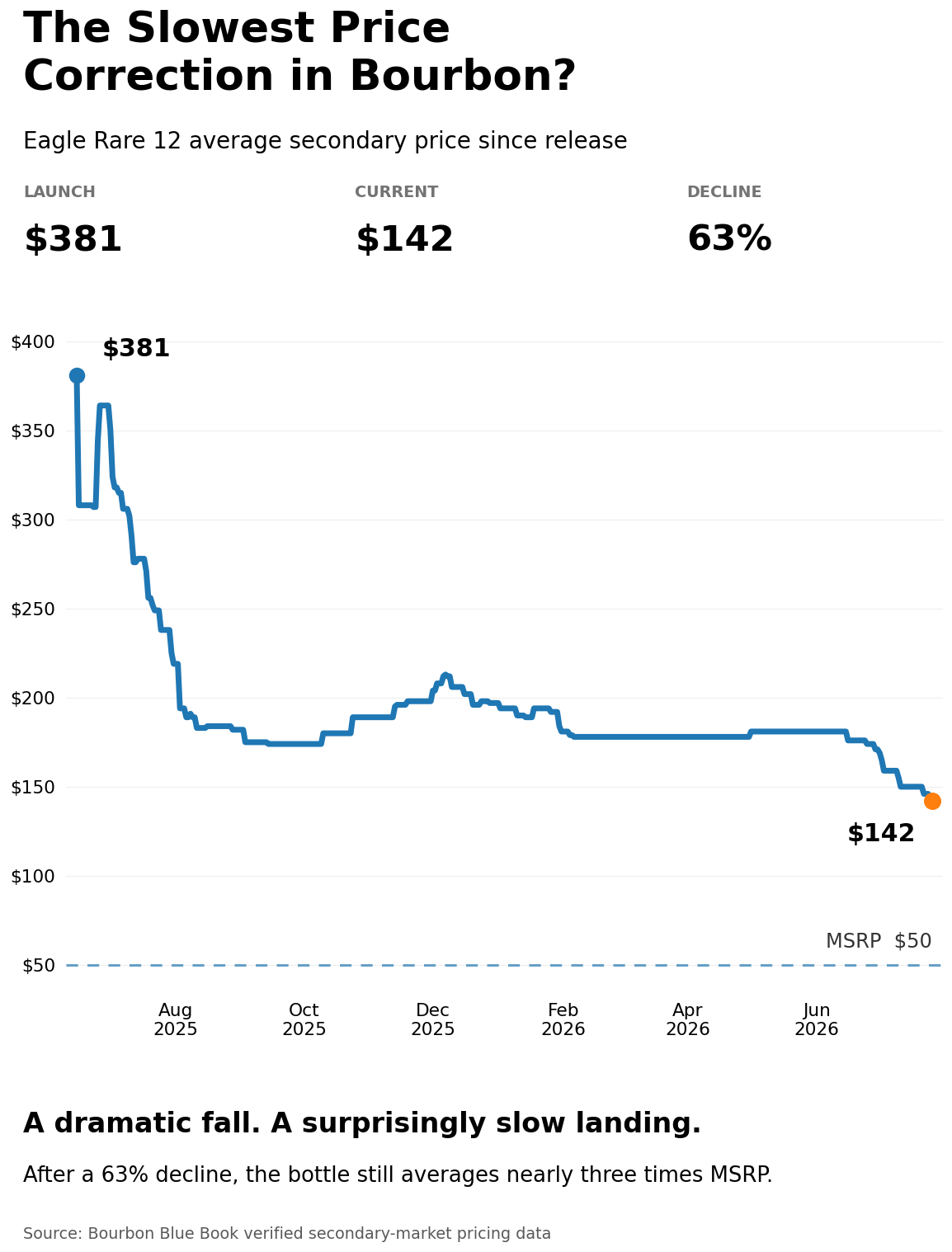
The average sale price has certainly come down. When we first began tracking verified transactions, it averaged around $381. Today it's closer to $142.
But that's only part of the story.
Instead of one sharp correction followed by stability, Eagle Rare 12 has spent the better part of a year drifting lower in small increments. Every few weeks it looks like buyers and sellers have finally agreed on what it's worth, only for another handful of verified transactions to quietly suggest otherwise.
At some point I stopped thinking this was a story about Eagle Rare 12.
It became a story about how bourbon markets discover value.
That's something I get to watch every week. Some bottles find their footing almost immediately. Others bounce around before settling in. Then there are bottles like Eagle Rare 12 that seem to ask the same question over and over again:
What am I actually worth?
Buffalo Trace answered that question one way.
The market answered it another.
Watching those two answers slowly move toward one another has been one of the more interesting things I've tracked this year.
If you're trying to understand Eagle Rare 12, it's tempting to compare it with bottles like Stagg or Old Fitzgerald simply because they're all allocated bourbons.
I don't think that's the right comparison.
The bottle that matters is sitting right beside it.
Eagle Rare 10.
When Eagle Rare 12 launched, early buyers paid significant premiums to own one first, pushing the average verified secondary price to roughly $381.
That kind of excitement isn't unusual.
What surprised me was how long it took the market to settle.
Today, the average verified secondary price sits around $142—a decline of roughly 63%—but it didn't get there quickly. Rather than one dramatic correction, the market has spent more than a year slowly discovering where the bottle belongs.
Watching that happen eventually led me back to a much simpler question.
Why $142?
To answer that, I kept coming back to Eagle Rare 10.
From a distance, the two bottles are remarkably similar. They share the same mash bill, the same distillery and nearly identical profiles. Eagle Rare 12 simply spends about two additional years in the barrel.
Buffalo Trace priced those two years accordingly.
Eagle Rare 10 carries a $40 MSRP.
Eagle Rare 12 debuted at $50.
In other words, Buffalo Trace believed those additional two years added about $10 of value.
The secondary market came to a very different conclusion.
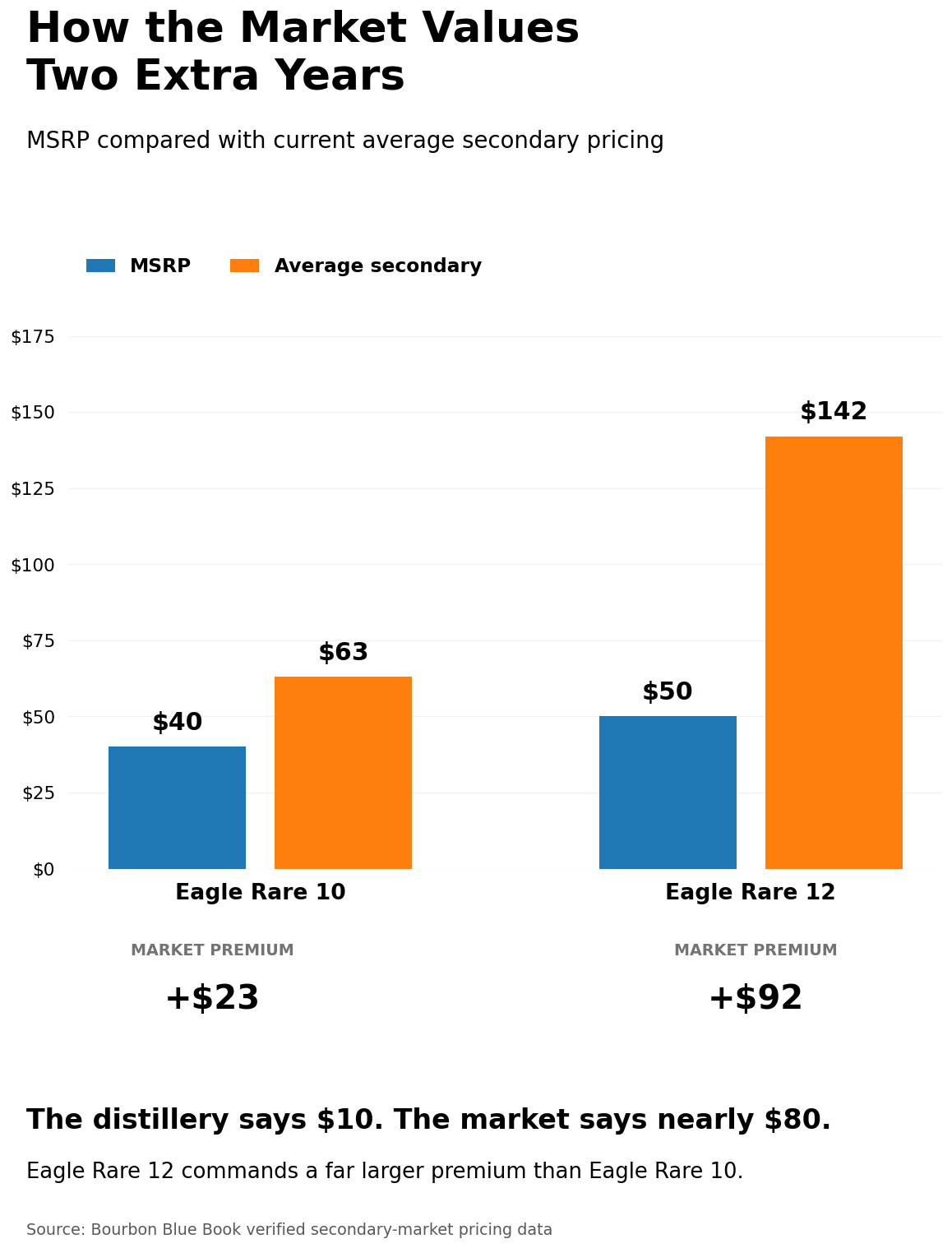
Today, Eagle Rare 10 averages around $63 on the secondary market, while Eagle Rare 12 averages about $142.
Instead of a $10 spread, collectors are paying roughly $80 more for the older bottle.
Why?
That's really the question. And I don't think the answer has much to do with age alone.
Every bottle in this article comes from verified secondary market transactions tracked in the Bourbon Blue Book, available exclusively inside the Bourboneur app. Instead of relying on asking prices or social media opinions, see where bottles are actually changing hands—and make more informed buying, selling and trading decisions.
One thing I've learned from writing about bourbon prices is that "worth it" means something different to everyone.
I've had Eagle Rare 12 several times now, and I genuinely enjoy it. The extra time in the barrel adds more oak, more richness and a longer finish. If you already enjoy Eagle Rare 10, there's a good chance you'll appreciate Eagle Rare 12 even more.
At its $50 MSRP, I think it's an outstanding value.
At today's average secondary price of around $140, the question changes.
You're no longer deciding whether Eagle Rare 12 is a good bourbon. You're deciding whether it's roughly an $80 better experience than Eagle Rare 10.
For me, the answer is probably no.
That isn't a criticism of Eagle Rare 12.
If anything, it's a compliment to Eagle Rare 10, which has quietly remained one of the better values in bourbon for years.
I also think reputation plays a larger role than many collectors realize.
Buffalo Trace has spent decades earning trust with bottles like Eagle Rare, Stagg and E.H. Taylor. When a new release arrives, collectors aren't evaluating it in isolation—they're buying into everything the distillery has built before it.
That's part of what they're paying for.
Not just older whiskey, but confidence in the name on the label.
And confidence has a habit of showing up in price.
Most bourbon releases don't follow this path.
When a highly anticipated bottle first reaches the secondary market, prices are driven by excitement. There are only a handful of sales, buyers are competing to be first and nobody really knows where the market will settle. Over the next few weeks, more transactions occur, expectations become grounded in actual sales and prices usually stabilize.
Eagle Rare 12 has been different.
What surprised me wasn't where it started. Nearly every sought-after Buffalo Trace release opens higher than it ultimately settles.
What surprised me was how slowly the market adjusted.
Instead of one sharp correction, the average price has drifted lower in stages. Just when it appears buyers and sellers have found common ground, another group of verified sales nudges the average a little lower.
I think there are a few reasons for that.
First, there simply aren't that many transactions. Compared with Eagle Rare 10, every Eagle Rare 12 sale carries more weight. With fewer data points, it naturally takes longer for the market to establish a consensus.
Second, Buffalo Trace has earned something many distilleries spend decades chasing: trust.
Collectors weren't evaluating Eagle Rare 12 as a brand-new bourbon. They were evaluating it as the next chapter in one of bourbon's most respected lineups. That reputation created expectations before the first bottle was ever opened, and expectations have a way of showing up in price.
Finally, buyers didn't all arrive at the same time.
Some wanted the bottle immediately and were willing to pay almost anything. Others waited for prices to soften. As those buyers entered the market over the course of the year, each new transaction helped reshape what "fair value" looked like.
That's why I find price history far more interesting than a single number.
A current average tells you where the market is today.
The trend tells you how it got there.
Looking at Eagle Rare 12, I don't see a bottle that's falling out of favor. I see a market becoming more informed with every verified transaction.
Whether today's average proves to be the long-term answer remains to be seen.
If I knew exactly where Eagle Rare 12 was headed, the Bourbon Blue Book would be a very different business.
The truth is, nobody knows.
The average may settle around today's level. It may drift lower as more bottles reach collectors. Or renewed demand could push prices back in the other direction. Markets have a way of humbling anyone who becomes too confident in predicting them.
What I do know is this:
The market knows far more today than it did a year ago.
When Eagle Rare 12 first appeared, buyers were making decisions with almost no information. Today, the average is built on hundreds of verified transactions instead of speculation or social media asking prices.
That's really the purpose of the Bourbon Blue Book.
It doesn't tell collectors what a bottle should be worth.
It shows what collectors have actually been willing to pay.
Sometimes that confirms your expectations. Sometimes it challenges them. Either way, it's grounded in real transactions.
Eagle Rare 12 has been one of the more fascinating bottles I've tracked because it reminds me that price discovery isn't an event.
It's a process.
Every verified sale adds another piece to the picture.
And if history is any guide, Eagle Rare 12 won't be the last bottle to teach us that lesson.
The Bourbon Blue Book inside the Bourboneur app tracks thousands of verified secondary transactions to help collectors make more informed buying, selling and trading decisions.
.png)


.png)
.png)
.png)
0 Comments